
Energy Savings Calculator
0203 193 8888


0203 193 8888
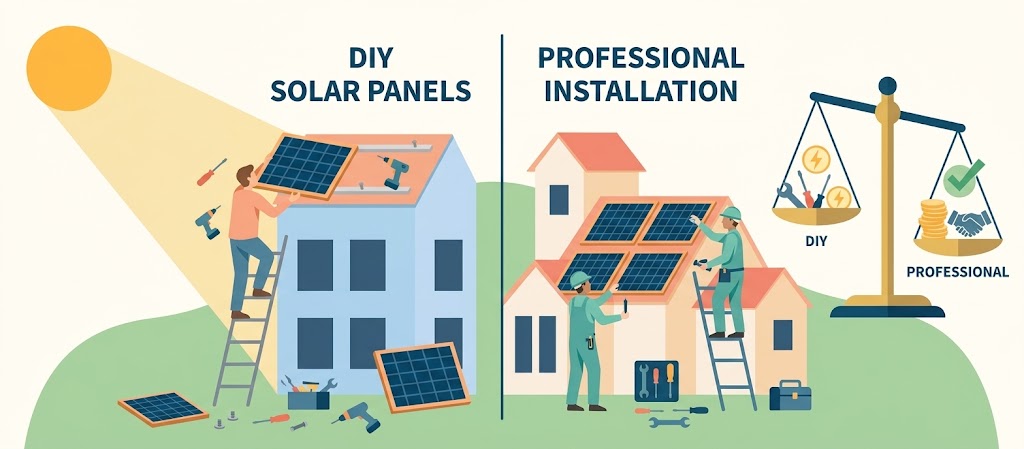
For many UK homeowners, the appeal of DIY solar panels comes down to one simple number: the cost of installation labour. With online tutorials, plug-in kits, and forums full of confident self-installers, cutting out professional fees from an already significant investment can feel like an obvious way to save. On paper, DIY solar looks cheaper. In practice, UK regulations, serious safety risks, and the loss of eligibility for schemes like MCS certification and the Smart Export Guarantee can turn those upfront savings into a costly mistake. This article gives you a clear, honest comparison of both routes, so you can decide what is genuinely right for your home.
Installing solar panels on your own home is legally permitted in the UK, and there is no law stopping a competent homeowner from fitting panels themselves. That said, legal does not mean unregulated. Any installation must still comply with building regulations, and all electrical work falls under Part P of the Building Regulations (in England and Wales), which governs the safety of domestic electrical installations in England and Wales.
Most solar panel installations on existing homes fall under permitted development rights, meaning you will not usually need full planning permission. However, this is not universal. Homeowners in listed buildings will require listed building consent. Those living in conservation areas, and those living in flats or maisonettes, should consult local regulations.
There is also a notification requirement that catches many DIYers off guard. There are two notification processes involved – the G98 notification is for smaller arrays and requires the electricity Distribution Network Operator (DNO) to be notified within 28 days. For solar systems over 3.68 kWp, you need to go through the G99 process before installation begins. Skipping this step, whether deliberately or through oversight, can leave your system unregistered and technically non-compliant.
The financial case for DIY solar starts to look less compelling once you compare like for like. A professional installation of a typical 3-4kW system for a UK home usually costs somewhere between £4,000 and £8,000, depending on panel quality, roof complexity, and whether battery storage is included. Buying the equipment alone for an equivalent DIY system typically costs £3,000 to £5,000.
At first glance, that gap of £1,000 to £3,000 looks like a straightforward saving. But it does not tell the whole story. A professional installation price includes far more than the panels and inverter:
DIYers often underestimate the hidden costs that eat into their savings. Equipment hire for scaffolding or roof access, the cost of a qualified electrician to sign off the final connection (since most homeowners cannot legally self-certify high-risk electrical work), failed inspections that require rework, and lost income from being unable to claim Smart Export Guarantee payments can all add up quickly.
Beyond the financial calculation, solar panel installation carries safety risks that should not be underestimated. Working at height is one of the most obvious dangers: fitting panels means working on a pitched roof, often carrying heavy, awkward panels without the scaffolding, harnesses, or edge protection that professional installers use as standard. Falls from height remain one of the most common causes of serious injury in home improvement projects.
The electrical risks are less obvious but arguably more serious. Solar panel systems operate at DC string voltages of potentially several hundred volts, far higher than the domestic mains supply most homeowners are used to. DC arcs are also harder to extinguish than AC faults, and unlike a standard circuit, solar panels generate electricity and stay live whenever there is daylight. They cannot simply be switched off and isolated the way a normal household circuit can. There is also a genuine fire risk from poor connections, incorrectly rated components, or cabling that has not been installed to the right standard. Building Regulations, Part P, and DNO Notification Requirements
In England and Wales, Part P compliance is one of the most misunderstood parts of a DIY solar project. Electrical work connected to a solar installation must either be self-certified by a registered competent person scheme member or signed off by local authority building control. Most DIY installers are not registered under a competent person scheme, which means the work must go through a separate, and often slower, building control inspection and sign-off process, adding time, cost, and paperwork that a professional installer would normally handle as a matter of course.
Then there is the DNO notification process. Systems up to 3.68kW single-phase generally fall under the simpler G98 notification, where you inform your Distribution Network Operator after installation. Larger systems require G99 approval, which must be granted before connection and can involve a longer assessment, sometimes taking several weeks depending on local network capacity.
For a professional installer, this paperwork is routine. They know which forms apply, submit them correctly, and factor typical timelines into the project. For a DIYer tackling this for the first time, it is easy to miss a step, submit the wrong notification type, or misunderstand what is required before switching a system on.
MCS (Microgeneration Certification Scheme) certification, or its equivalent Flexi-Orb, is the industry standard that confirms a solar installation was designed and fitted to a recognised quality benchmark. Installers hold MCS accreditation through training, audited installations, and ongoing compliance checks.
This is the point where DIY solar runs into its biggest obstacle: certification applies to accredited installers, not to the equipment itself. In practical terms, this means a self-installed system generally cannot be MCS-certified, no matter how good the panels or how carefully the work is carried out.
That matters because MCS or Flexi-Orb certification is a requirement for the Smart Export Guarantee (SEG), the scheme that pays homeowners for excess electricity exported back to the grid. Without MCS certification, a DIY installation is typically ineligible for SEG payments, removing a meaningful part of the long-term financial return that makes solar attractive in the first place.
Warranties are another area where DIY solar quietly loses ground. Most manufacturer warranties on panels, inverters, and batteries are conditional on professional installation by an accredited installer. DIY installation may invalidate some manufacturer warranties; check the terms before buying.
Home insurance is a similar story. If a DIY solar installation contributes to damage, whether that is a roof leak, an electrical fault, or a fire, insurers may reduce a payout or refuse a claim outright if the work was not carried out and certified to the required standard. This is a risk many homeowners only discover after something has already gone wrong.
.
When you weigh everything above together, a professional installer brings far more to the table than simply fitting panels:
For South East England homeowners in particular, where roof types, conservation areas, and local DNO requirements can vary significantly between towns, that local knowledge and accredited expertise often proves just as valuable as the labour itself.
DIY is not always the wrong answer. Small-scale, off-grid solar, such as plug-in solar kits for a shed, summerhouse, or small outbuilding that is not connected to your home’s electrical system, can be a reasonable and low-risk project for a confident DIYer.
If you are still weighing up your options, ask yourself a few honest questions: how large is the system you need, and does it involve grid connection? What is your realistic budget once hidden costs are included? Do you have genuine electrical or construction trade experience, not just enthusiasm? And does SEG income and a valid manufacturer warranty matter to your long-term plans? For most homeowners, the answers point clearly towards professional installation.
Can I install solar panels myself in the UK?
Yes, it is legal to install solar panels on your own home in the UK, provided the work complies with building regulations and Part P electrical safety standards. You will also need to notify your Distribution Network Operator under the G98 or G99 rules before or after connecting to the grid. However, legal does not mean straightforward. Most DIY installers are not registered under a competent person scheme, so electrical work typically needs sign-off from local authority building control, and the system generally cannot receive MCS certification, which limits access to incentives like the Smart Export Guarantee.
Do I need a qualified electrician to install solar panels?
You do not strictly need to be a qualified electrician to fit the panels themselves. Still, the electrical connection work, including wiring into your consumer unit and the final grid connection, falls under Part P regulations and involves genuinely dangerous DC voltages of 600V to 1000V. In practice, most homeowners bring in a qualified electrician for this stage, which reduces the potential savings of going fully DIY. A professional, MCS-certified installer handles the entire process, including the electrical work, to the required safety standard.
Will DIY solar panels void my home insurance?
Not automatically, but it is a real risk. Most home insurers expect any electrical work, including solar installations, to be carried out and certified to the relevant safety standards. If a DIY installation later contributes to damage, such as a roof leak, electrical fault, or fire, your insurer may reduce or refuse a claim if the work was not properly certified. It is worth checking directly with your insurer before starting a DIY project, since policy wording varies, and disclosing a self-installed system is generally required.
Can I still get the Smart Export Guarantee with a DIY install?
Generally, no. The Smart Export Guarantee requires your solar installation to be MCS-certified, and MCS certification applies to accredited installers rather than to the equipment itself. Since most DIY installations cannot be MCS-certified, they are typically ineligible for SEG payments, meaning you would lose access to income for any excess electricity you export back to the grid. This is one of the most significant long-term financial drawbacks of going down the DIY route for a grid-connected system.
How much does professional solar installation cost compared to DIY?
A professional installation of a typical 3-4kW system for a UK home usually costs between £4,000 and £8,000, while DIY equipment alone typically costs £3,000 to £5,000. The professional price includes labour, scaffolding, electrical certification, and MCS paperwork, all of which DIYers must source or arrange separately, often at additional cost. Once you factor in hidden expenses like equipment hire, electrician fees, and lost SEG income, the real-world gap between DIY and professional installation is usually much smaller than the headline equipment prices suggest.
DIY solar can make sense for small, genuinely off-grid projects. For a grid-connected domestic system, the regulatory, certification and safety requirements mean that professional installation from The Solar Co will usually be the more practical option.
Back to Blog