
Energy Savings Calculator
0203 193 8888


0203 193 8888
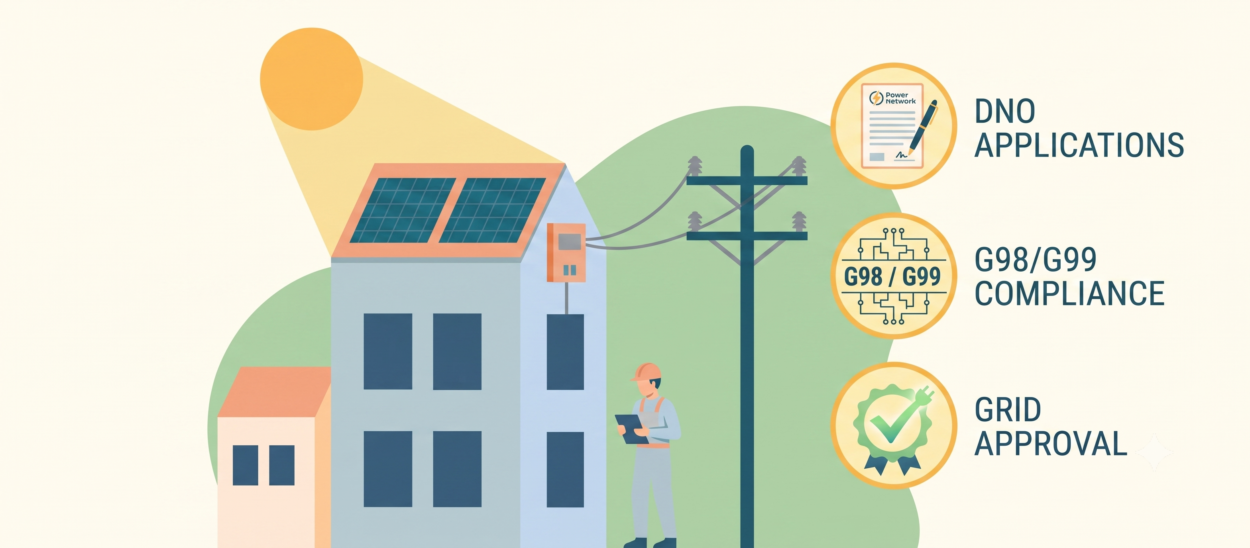
Most homeowners planning a solar installation spend their time thinking about panel placement, system size, and return on investment. What often catches them by surprise is learning that connecting solar panels to the UK grid is not simply a matter of wiring them up and flipping a switch. Every solar installation must be formally registered with your local Distribution Network Operator under either the G98 or G99 engineering standard before your system can legally export electricity to the grid. The good news is that for the vast majority of domestic installations, this entire process is handled by your MCS-accredited installer, causes no delays, and costs you nothing extra. This guide explains what G98 and G99 applications are, which one is likely to apply to your home, and exactly what to expect at each stage of the process.
Your DNO, or Distribution Network Operator, is the company that owns and maintains the physical cables, transformers, and substations that deliver electricity to your home. In South East England, that organisation is UK Power Networks, one of the largest network operators in the country. They are responsible for keeping the local grid safe, stable, and capable of handling the electricity flowing through it.
When you install solar panels, your home transitions from being purely a consumer of electricity to also being a small generator. The DNO needs to know about any new generation equipment connected to their network, including solar PV systems and battery storage, so they can account for the additional electricity flow and manage the grid safely.
It is important to understand that your DNO is an entirely separate organisation from your energy supplier. Your energy supplier sells you electricity and will eventually pay you under the Smart Export Guarantee (SEG) for any surplus you export. Your DNO, by contrast, owns the infrastructure your electricity travels along. Many homeowners confuse the two, but they serve very different functions in the energy system.
Failing to notify the DNO is not a minor administrative oversight. The consequences can be significant, and we cover them in full further down this guide.
G98 and G99 are engineering standards published by the Energy Networks Association (ENA). They set the technical and procedural requirements for connecting small-scale electricity generation, including solar PV systems, to the public electricity network.
Think of them as the two regulatory routes available to residential solar customers in the UK. Which route applies to your installation is determined primarily by the size of your system. The standards were introduced to replace an older patchwork of inconsistent local processes, creating a single, uniform approach that applies across all DNOs in the country.
A third standard, G100, exists for even larger systems, but this is not relevant to typical domestic solar installations.
The most important thing to know is that identifying which route applies, completing the required forms, and submitting the application is your installer’s responsibility, not yours. If you choose an MCS-accredited installer, this is a standard part of the service they provide.
G98 is the simpler of the two routes and covers the majority of standard home solar installations. It applies to systems where the total inverter output capacity is 3.68kW or below per phase, which includes most three- to five-panel systems installed on a typical semi-detached or detached property.
Under G98, your installer follows a fit-and-inform principle. This means the system can be fully installed and commissioned first, with the DNO notified within 28 days afterwards. There is no waiting period before work can begin, and no approval is required before the panels go up.
The G98 notification itself is free of charge. Your installer completes a standard form with information about the system, including inverter specifications and their own MCS installer credentials, and submits it to the DNO on your behalf. The DNO does not issue an approval or confirmation under this route; the notification alone is sufficient for full compliance.
For most homeowners in South East England, G98 is the only grid connection process they will ever encounter, and they will notice very little of it happening. It runs entirely in the background while your installer handles the commissioning paperwork.
G99 applies when the total inverter output capacity of your system exceeds 3.68kW per phase, or when certain battery storage systems are added. Where G98 allows the installer to act first and notify afterwards, G99 is fundamentally different: the application must be submitted and approved by the DNO before installation can begin.
This is the critical distinction, and it has real implications for timelines. A G99 application involves a more detailed technical submission, including system design documents, protection relay settings, single-line diagrams showing how the system connects to the grid, and a DNO impact assessment to confirm the local network can accommodate the additional generation.
Timelines for G99 vary. For straightforward domestic applications, fast-track approvals using the Simplified G99 (SGI) process can come through in around 10 working days. More complex cases, where the DNO needs to assess local network capacity in detail, can take 8 to 12 weeks. Your installer will be transparent about which timescale applies to your specific system before any work is scheduled.
In terms of cost, G99 applications are generally free to submit for domestic systems, though some DNOs may charge administrative fees for more complex network assessments. Your installer will advise if any fees apply to your situation.
The decision point is straightforward in most cases. If your system’s total inverter output capacity is below 3.68kW per phase, you need a G98 notification. If it exceeds that threshold, G99 applies.
Adding battery storage can also change the picture. Even if your solar panels alone would fall under G98, certain batteries with high charge and discharge rates may push the combined system into G99 territory. This is assessed at the design stage, so your installer will know the required route before any paperwork is raised.
One common misunderstanding is worth addressing directly: the panel array size in kilowatts does not automatically determine which route applies. A 4kWp panel array does not automatically mean G99. What matters is the inverter output capacity, not the headline wattage of the panels themselves. A 4kWp array can be paired with a 3.68kW inverter and remain comfortably within G98. Your installer’s system design will reflect this.
For easy reference, here is a plain comparison of the two routes:
Not submitting a DNO application is not a minor administrative oversight. It is a compliance failure with a range of serious consequences that can follow homeowners for years after installation.
The most immediate financial impact is on Smart Export Guarantee eligibility. SEG payments, which allow you to earn money for surplus electricity exported back to the grid, require a valid DNO application on record. Without one, you cannot register with a supplier for SEG and you lose access to that ongoing income stream.
Home insurance is another area of risk. Many standard household insurance policies require that any modifications to the property, including solar panel installations, are carried out in compliance with relevant regulations. A missing or incomplete DNO notification could invalidate your policy or complicate any future claims.
Property sales are increasingly affected as well. Mortgage lenders and conveyancing solicitors now routinely check for DNO registration during the sale process. An installation that lacks the correct paperwork can delay or derail a sale, and may require retrospective applications that take time and cause friction with prospective buyers.
Beyond the financial risks, there are genuine safety and liability concerns. If a system connected without proper DNO notification causes a fault on the local network, the homeowner could face significant liability.
By contrast, an MCS-accredited installer is contractually required to submit the DNO application on your behalf and ensure it is correctly filed. This is one of the core reasons to choose a certified professional over an uncertified tradesperson offering a lower price.
Yes, in a meaningful way. A valid DNO application, whether G98 or G99, is a prerequisite for registering under the Smart Export Guarantee.
The SEG scheme allows homeowners to export unused solar electricity back to the national grid and receive payment from their energy supplier at a rate per kilowatt-hour. The exact rate varies by supplier, so it is worth comparing available tariffs once your system is installed and your registration is complete.
It is important to understand that the DNO application itself does not register you for SEG. That is a separate step, completed directly with your chosen energy supplier after installation. However, your supplier will require evidence of a compliant installation before accepting your registration, and a correctly filed DNO notification forms part of that evidence.
MCS certification is the other key requirement for SEG registration. Both the products installed and the installer carrying out the work must hold MCS certification for your application to be accepted by your supplier.
Knowing the sequence of events can make the whole process feel much more manageable.
Step 1: Survey and system design. Your installer visits the property, assesses your roof, energy use, and any existing electrical setup, and determines the system size and configuration. At this stage, they will identify whether your installation falls under G98 or G99.
Step 2 (G98 path): With a G98 system, installation and commissioning proceed on your agreed date with no waiting period. Your installer prepares the G98 notification form and submits it to the DNO within 28 days of commissioning. From your perspective, this happens entirely in the background.
Step 2 (G99 path): With a G99 system, your installer prepares a detailed technical application pack and submits it to the DNO before scheduling your installation date. You will be informed of the expected approval timeline, and your installation date is confirmed once approval is received.
Step 3 (G99 only): The DNO reviews the application, assesses local network capacity, and returns either a full approval, a conditional approval with modifications required, or a request for further information. Your installer manages any back-and-forth with the DNO on your behalf.
Step 4: Installation and commissioning. Panels, inverter, and any battery storage are installed. The system is tested and a commissioning certificate is issued.
Step 5: Paperwork complete. Your MCS installation certificate is issued, the G98 notification or G99 approval is filed, and you can proceed to register with your preferred energy supplier for Smart Export Guarantee payments.
Do I need to do anything myself to get DNO approval, or does my installer handle it?
Your MCS-accredited installer handles the full DNO application on your behalf. You do not need to contact the DNO yourself, complete any forms, or submit any documents. Handling the grid connection notification is a standard part of the service an accredited installer provides as part of your installation. If you are ever asked to manage this process yourself by an installer, it may be a sign that they are not properly accredited and it is worth checking their credentials before proceeding.
How long does grid connection approval take for a standard home solar installation?
For G98 installations, which cover most standard domestic systems, there is no approval process and no delay before installation can begin. The notification is submitted after commissioning and requires no response from the DNO. For G99 installations, the timeline ranges from approximately 10 working days for straightforward fast-track cases to 8 to 12 weeks for more complex assessments. Your installer will give you a clear picture of the expected timeline during the design and survey stage.
Will I need a G99 application if I add a battery to my existing solar panels?
Possibly. Whether adding battery storage triggers a G99 requirement depends on the inverter capacity of the battery system. If the combined output of your existing solar inverter and the new battery inverter remains below 3.68kW per phase, G98 still applies. If it crosses that threshold, G99 will be required before the battery can be installed. Your installer will assess this as part of the battery design process and let you know which route applies before any work begins.
What is the difference between the DNO and my energy supplier?
They are entirely separate organisations that serve different functions. Your DNO (in South East England, that is UK Power Networks) owns and maintains the physical electricity network that carries power to and from your home. They are responsible for the cables, transformers, and substations in your area. Your energy supplier, by contrast, is the company you pay your bills to, and the company that will pay you under the SEG scheme for exported electricity. They buy and sell electricity but do not own the infrastructure it travels along.
Can I lose my SEG payments if my DNO application was not submitted correctly?
Yes. Smart Export Guarantee eligibility requires a valid, correctly filed DNO application to be on record. If your installation was carried out without a proper notification, or if the application contained errors, it could prevent your SEG registration from being accepted by your energy supplier. This is one of the most important reasons to use an MCS-accredited installer: they are obligated to handle the DNO notification correctly and can be held accountable if they do not.
For most homeowners, the G98 or G99 application process is something that happens entirely behind the scenes. Your installer manages it, your DNO processes it, and by the time your system is commissioned and certified, the grid connection paperwork is already in place. From your side, the practical experience is seamless.
The risk, as this guide has made clear, lies in choosing an installer who is not MCS-accredited and may skip or misfile the DNO notification. The consequences range from losing SEG income to complications with home insurance and property sales, and they can emerge long after the panels are installed.
The Solar Co handles all grid connection paperwork as standard, covering G98 notifications and G99 applications for every installation we carry out across South East England. If you are ready to explore solar for your home, request your free survey today and let our team take care of everything, from design through to final registration.
Request Your Free Solar Survey
Back to Blog