
Energy Savings Calculator
0203 193 8888


0203 193 8888
Estimated reading time: 7 minutes
Rent-a-roof arrangements offered some homeowners solar panels without an upfront installation bill in return for granting a solar company long-term rights over the roof. The model expanded during the early Feed-in Tariff (FIT) years and became less attractive as new-installation tariffs fell. Existing leases can still affect sales and remortgages, so this guide explains how they worked and what to check today.
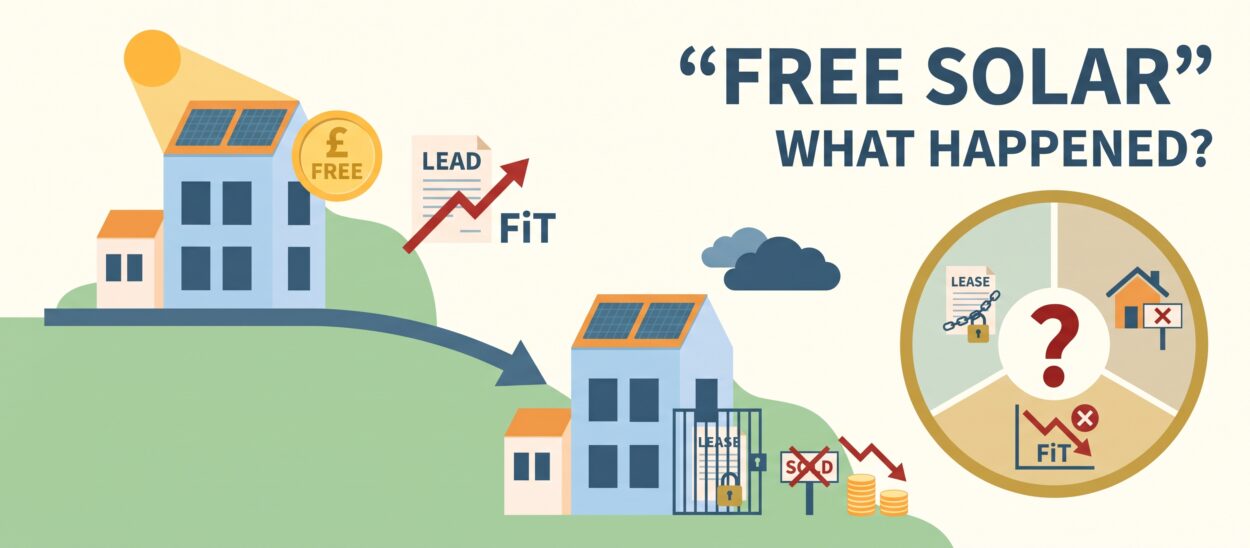
In a typical rent-a-roof deal, a provider installed and owned the solar panels in exchange for a long lease or other rights over the roof, commonly lasting about 20–25 years. The precise ownership, access and maintenance terms depended on the agreement.
Under many deals, the provider received the FIT generation income while the householder could use some electricity generated during daylight hours. Export income and responsibility for equipment varied by contract; the original agreement is the authority.
These deals became particularly visible in the early 2010s when FIT payments made third-party ownership commercially attractive. Exact take-up and peak years would require scheme-specific market data.
Some arrangements involved a registered roof-space lease or title restriction. Others could be structured differently. Buyers and owners should check the property’s title and the original contract rather than assume every agreement was registered identically.
FIT rate reductions for new installations from 2012 made many new rent-a-roof deals less attractive. The commercial viability of a particular arrangement depended on the tariff, installation cost and financing model.
The FIT scheme closed to new applications from 1 April 2019, subject to limited transitional arrangements. Crucially, accredited systems continued receiving FIT support for their eligibility period, typically 20 years; the closure did not terminate existing payments or leases.
The Smart Export Guarantee (SEG) began on 1 January 2020 and requires eligible suppliers to offer payment for metered exports from qualifying generators. It does not automatically transfer export income or ownership from a third-party solar provider to the homeowner; entitlement depends on the contract and metering arrangements.
The economics of offering new rent-a-roof deals changed as FIT rates fell and new FIT accreditation ended. Avoid claiming that no UK provider offered such deals after 2021 without market-wide evidence: some alternative third-party-funded models may still exist.
The restrictions depended on the contract, so a buyer or homeowner should look for the following possible issues rather than assume they applied to every scheme:
● A roof-space lease or title restriction may bind successors in title and require attention during a sale or remortgage.
● The provider’s rights may affect roof repairs, alterations or access; check which works require notice or consent. A sale itself is not necessarily prohibited.
● Some agreements set out compensation or procedures when panels are removed, or output is interrupted for roof works. Whether any payment is due depends on the wording.
● Early termination and buyout rights vary. Some leases may contain an agreed mechanism; others require negotiation with the current leaseholder.
None of these catches was necessarily deal-breakers on their own, but together they meant a decision made in a single afternoon could end up shaping what a homeowner could do with their property for the next two decades.
UK Finance’s Lenders’ Handbook sets minimum requirements for roof-space solar leases in England and Wales. A lender may require consent and review whether a lease meets its criteria; if it does not, the lender may request changes or decline to lend.
During conveyancing, the buyer’s solicitor should review the title, lease, rights of access, insurance and repair obligations, and the proposed lender’s requirements. A roof-space lease is not automatically a bar to a mortgage.
A non-compliant or unclear lease can delay a sale or remortgage while the parties seek documents, a deed of variation or lender consent. The outcome depends on the lease and the lender; it’s not inevitable.
Yes. A 25-year lease signed in 2011 could run until 2036, and a 20-year lease signed in 2012 could run until 2032. These are illustrative dates, not estimates of how many UK homes still have such agreements.
Homeowners who have inherited a lease, whether through buying a property or simply forgetting about one signed years ago, should start by locating the original contract and confirming exactly how much of the term remains. The paperwork should set out the start date, term length, and any conditions attached to the roof.
Ask the current leaseholder whether a buyout or variation is possible and obtain a written quotation. Do not assume that most providers will agree to a settlement: their willingness and pricing depend on the contract and commercial position.
Where a sale is blocked by a lease issue, ask the conveyancer whether a deed of variation, lender consent or another remedy is appropriate. Indemnity insurance isn’t a universal solution and may not meet the lender’s requirements.
If you buy and own a solar installation outright, you avoid granting a third party a rent-a-roof lease for that system. However, normal planning, building, grid-connection, mortgage and other property restrictions may still apply.
Where the homeowner owns the system and qualifies for the SEG, export payments generally go to the eligible generator under their chosen tariff. A rent-a-roof contract may allocate income differently. Owning a system does not guarantee a particular SEG rate or any fixed return.
Qualifying solar panel installations in residential accommodation currently benefit from 0% VAT until 31 March 2027. This reduces installation tax, but it does not remove the upfront capital cost or make ownership affordable for every household.
The Solar Co should confirm that its standard customer contract transfers ownership of the installed system and creates no third-party roof-space lease. Avoid an unverified blanket claim about every system it has ever installed.
If you’re buying a property with a rent-a-roof lease in place, a few early checks can save considerable hassle later and put you in a stronger negotiating position.
● Ask the seller for the original lease agreement and confirm exactly how many years remain.
● Check whether the lease is transferable and what obligations will pass to you as the new owner.
● Involve your solicitor early to review any restrictions on future roof work, extensions, or resale.
● Factor any restrictions or buyout costs into your offer and negotiations before exchanging contracts.
Working through these points before you commit gives you a clear picture of what you’re taking on, rather than discovering the details after you’ve already exchanged and the lease becomes your problem to manage.
Traditional FIT-funded rent-a-roof schemes became less attractive after tariff reductions and the FIT scheme’s closure to new applicants on 1 April 2019. It is too broad to say that no third-party-funded or roof-lease model is available anywhere in the UK today.
Possibly. Check the lease for any early termination or purchase provision, then ask the current leaseholder for its terms. If a settlement is proposed, have a solicitor review its legal effect before you pay.
Not automatically. UK Finance publishes requirements for roof-space solar leases, and individual lenders can have additional criteria. A solicitor should check the lease early and obtain the proposed lender’s view.
The FIT scheme closed to new applications from 1 April 2019. Existing accredited installations generally continue to receive FIT payments for their remaining eligibility period; the scheme was not cancelled for existing participants.
Outright ownership generally gives homeowners more control over the equipment and potential export income, but it involves an upfront cost and does not remove ordinary property restrictions. Compare the actual contract, total cost and long-term obligations rather than assume every lease is inferior.
For some households, rent-a-roof deals delivered electricity savings without an upfront purchase. Others faced roof-access issues or mortgage requirements. The decisive factor is the wording of the individual agreement and whether it meets current lender criteria.
Today, an owned solar installation can benefit from SEG export payments where eligible and 0% VAT on qualifying installations until 31 March 2027. Anyone with a legacy lease should obtain the contract and title documents before deciding whether to sell, remortgage, or buy out.
Back to Blog