
Energy Savings Calculator
0203 193 8888


0203 193 8888
Estimated reading time: 9 minutes
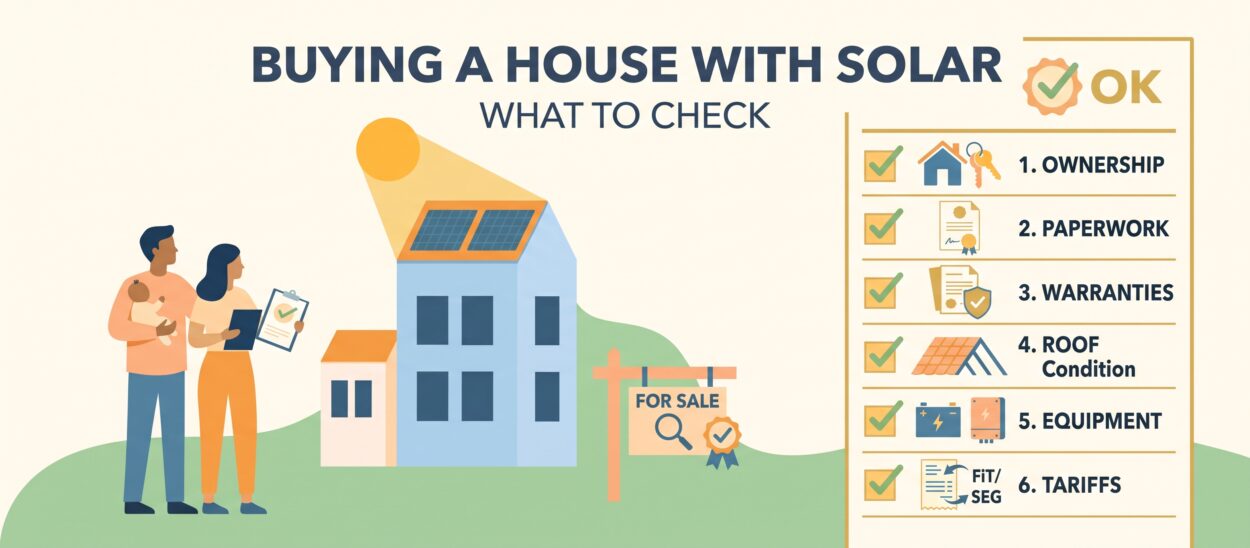
Solar panels are a familiar sight on rooftops across the South East and can be a useful asset for buyers. Before purchasing, check who owns the equipment, what income rights transfer, and whether the system is safe and working. This checklist focuses on England and Wales, covering ownership documentation, FiT and export arrangements, roof-space leases, system condition and mortgage requirements. Procedures differ elsewhere in the UK.
Before anything else, establish exactly what you are buying and whether the solar equipment is included in the deal.
• Review the TA6 Property Information Form and TA10 Fittings and Contents Form, and have your solicitor confirm in the contract which panels, inverter, battery and associated rights are included.
• Get written confirmation from the seller’s solicitor rather than relying on a verbal assurance from the estate agent.
• Ask whether the system is owned outright, on finance, or leased from a third party, as this changes what you are actually buying.
• Request the original MCS certificate, where applicable, together with electrical, commissioning and relevant building-regulations documentation. An MCS certificate alone does not establish current safety or compliance with every aspect of the law.
An estate agent’s brochure is not sufficient confirmation of ownership or the sale terms. Ask your solicitor to verify the documents, any outstanding finance or third-party rights, and the contractual arrangements before exchange.
One of the most valuable things a solar system can carry over is an income stream, but only if the Feed-in Tariff change of ownership is handled correctly.
• Ask if the property still benefits from a legacy FiT contract, which can run for 20 to 25 years from installation and pays for generation as well as export.
• Obtain the existing FiT licensee’s details and agree its ownership-transfer requirements with the seller. For a typical domestic MCS-FiT installation, contact the FiT licensee rather than notifying Ofgem directly.
• Check the existing export arrangement, including any SEG tariff, and contact your chosen export supplier about opening an account in your name. Do not assume the seller’s tariff or contract transfers to you.
• FiT payment records do not update automatically when a house is sold. Obtain evidence of system ownership and a dated generation-meter reading at completion, and confirm how the licensee will allocate payments across the transfer date.
Ask for recent FiT statements, the applicable tariff, and the remaining payment term, rather than estimating income based on the system’s age alone. A FiT installation can retain generation payments while receiving SEG for exports, but it cannot receive both FiT export and SEG payments for the same electricity.
A roof-space lease requires additional conveyancing checks because a third party may own the equipment and retain the income rights. Identify the arrangement early and have your solicitor review its implications for your lender and your use of the roof.
• Ask whether the panels were installed under a free rent-a-roof scheme, common between roughly 2010 and 2016, where a third party owns the panels and leases the roof space.
• Request the lease and ask your solicitor to assess it against the UK Finance minimum requirements and your lender’s specific instructions. The system’s age alone does not establish whether the lease is acceptable.
• Some original solar companies have closed or transferred their installations to another owner. Establish the current panel owner and roof-space leaseholder; an ownership change may not have been communicated to the homeowner.
• A lease your lender cannot accept may require a Deed of Variation or another agreed remedy. Also check access, maintenance, and insurance responsibilities; who pays to remove and reinstall the panels for roof repairs; and what happens at the end of the lease.
Rent-a-roof leases are not automatically a dealbreaker, and plenty of purchases with them complete without issue, but they need to be identified and reviewed early rather than discovered a week before your target completion date.
Assess the Condition and Age of the System
An inherited solar panel system check should always include an assessment of the equipment’s physical condition and performance history, not just the paperwork.
• Ask when the panels and inverter were installed. Panels typically last 25 years or more, but inverters usually need to be replaced after 8 to 12 years.
• Look for visible signs of damage, cracked cells, corrosion on the mounting frame, or new shading from trees or extensions.
• Request recent generation data or monitoring app history to check the system is performing as expected.
• Consider commissioning an independent solar survey rather than relying solely on a standard homebuyer’s report.
A system that is nearing the end of its inverter life is not a reason to walk away from the purchase, but it is a useful bargaining point, and it means you can budget for a replacement rather than being caught out by a sudden drop in generation.
Electrical certificates and grid-connection records help establish how the system was installed and connected. They do not replace an assessment of its current condition.
• Ask for the MCS certificate where applicable, the Electrical Installation Certificate and relevant building-regulations records. An electrician should assess the installation against the requirements applicable to its age and any later alterations; an older installation is not automatically unsafe because standards have since changed.
• Request evidence of the appropriate Distribution Network Operator (DNO) notification or connection approval. G98 normally provides a connect-and-notify route for qualifying small installations; G99 generally requires prior approval. Older systems may have valid records under predecessor standards G83 or G59.
• Ask for any subsequent inspection or maintenance records, relevant building-regulations completion or compliance records, and any planning permission or listed-building consent required for the installation.
• If a battery is included, request installation and commissioning records, the model and serial number, usable capacity, available battery-health data and warranty terms. Confirm whether the warranty transfers to you and whether registration is required.
Missing or incomplete safety paperwork does not necessarily mean the installation is unsafe, but it does mean you cannot verify that yourself, which is exactly the kind of gap an independent inspection is designed to close.
Solar panels do not automatically prevent a mortgage, but a roof-space lease or third-party ownership can add checks. Lender requirements vary, so establish the position early.
• Tell your mortgage lender early that the property has solar panels, as most lenders require their consent to any roof-space lease.
• Be aware that leased or third-party-owned systems attract more scrutiny than owned systems and can slow down the application.
• Ask your solicitor to check the lease terms against your lender’s specific requirements before you commit to a completion date.
• Budget extra time in your purchase timeline if any lease compliance issues need resolving.
Being upfront with your broker and lender from the outset is the simplest way to keep a solar-equipped purchase moving at the same pace as any other, rather than hitting a last-minute snag during underwriting.
Nesting and debris beneath panels can obstruct drainage, affect the roof and create maintenance problems. Check for signs of pests or damage without assuming that every unprotected array is faulty.
• Look underneath the panels for signs of nesting, droppings, or gaps where birds could get in.
• Ask whether suitable bird-proofing mesh has been fitted and have a specialist check any damaged or exposed cabling. Any proposed mesh should be compatible with the mounting system and warranty requirements.
• Factor in the cost of retrofitting bird proofing if it has not been done, particularly in areas prone to nesting.
• Check for any related roof damage caused by nesting debris or blocked guttering.
Bird proofing is a relatively low-cost addition, but it is worth pricing in as part of your first-year budget for the property, especially if the previous owner has not mentioned it or the panels sit on a roof close to trees or hedgerows.
Before you exchange, it is worth putting these questions directly to the seller, the estate agent, or your conveyancing solicitor.
• Who owns the system outright, and is that ownership being transferred to you as part of the sale?
• Is there a live FiT or SEG contract, and has the change of ownership process been started?
• Is there a roof-space lease, and has it been checked for mortgage lender compliance?
• What is the age and condition of the panels, inverter and battery, and are there any outstanding warranties?
Getting clear answers to these four questions in writing, ideally through your solicitor’s enquiries rather than a casual conversation at a viewing, is the single most effective way to avoid unpleasant surprises after you have moved in.
No. For a typical domestic MCS-FiT installation, contact the existing FiT licensee and provide the required evidence of ownership, the transfer date, and meter readings. The licensee updates the Central FiT Register. Delayed paperwork can delay or complicate payments, but a house sale does not, by itself, cancel the installation’s FiT accreditation. Agree the process before exchange and submit the completion evidence promptly afterwards.
Panels owned outright rarely cause issues, but a roof-space lease or a third-party ownership arrangement can. Most lenders require a copy of the lease and will check it against the UK Finance Mortgage Lenders’ Handbook before granting consent. Older or non-compliant leases may require a Deed of Variation, which can delay your application. Flagging the solar panels to your lender and solicitor as early as possible is the best way to avoid delays close to your completion date.
A rent-a-roof scheme is an arrangement, common between roughly 2010 and 2016, in which a third-party company installed panels for free in exchange for owning them and leasing your roof space, keeping the FiT income for itself. When buying a property with this setup, you need a copy of the lease to verify that it is compliant with the mortgage lender. Some of the original companies have since closed or changed hands, which can make it slower to confirm who currently owns the system and holds the lease.
Ask for the original documents and distinguish the panel product warranty, performance guarantee, inverter warranty, battery warranty and workmanship cover. Check remaining terms, exclusions and whether each transfers to a new owner, including any registration deadline or fee. If records are missing, contact the manufacturer or original installer with the model and serial numbers; an independent installer cannot necessarily reconstruct or validate the cover.
A standard homebuyer’s survey may exclude detailed testing of solar equipment, so confirm the surveyor’s scope. A suitably qualified solar specialist or electrician can assess equipment condition, electrical safety and performance, with roof and structural questions referred to an appropriate surveyor. This is particularly useful for older installations or incomplete records. Agree the inspection scope in advance.
Buying a house with solar panels can reduce future electricity purchases, but the benefit depends on ownership, performance and any lease terms. It does not guarantee a higher property value. Before exchange, verify the sale documents, FiT and export arrangements, lender requirements, system condition and relevant permissions. Confirm who will handle the transfer paperwork, and retain the dated meter readings upon completion.
Back to Blog