
Energy Savings Calculator
0203 193 8888


0203 193 8888
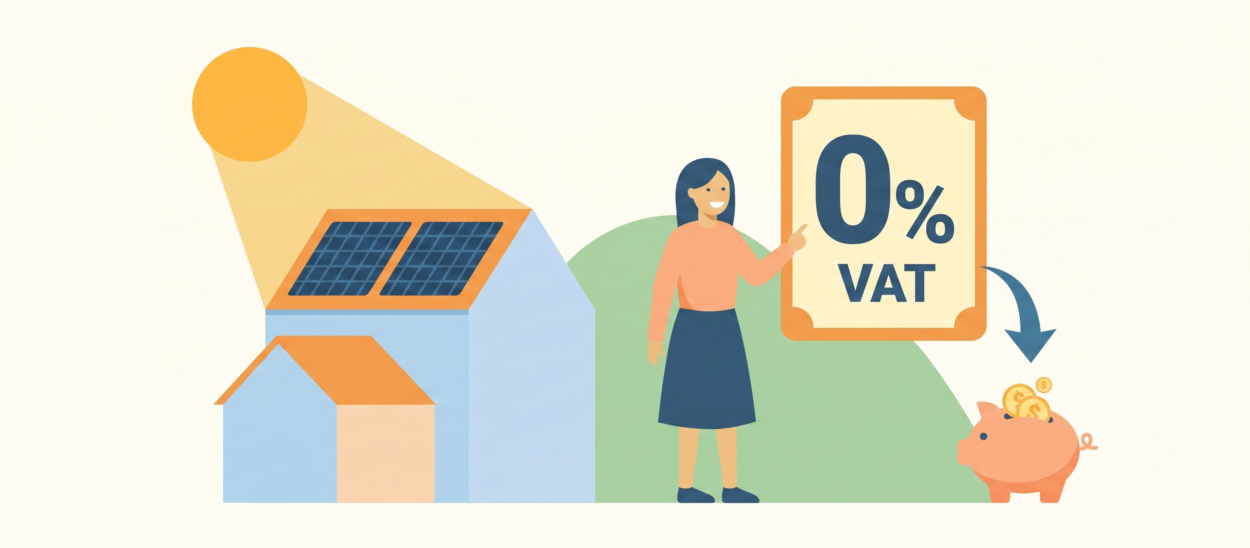
One piece of good news that immediately changes the maths, if you are considering installing solar panels, is that solar panels in the UK are currently zero-rated for VAT. The relief is applied automatically by your installer and not reclaimed later.
The policy is a deliberate part of the government’s push to support household decarbonisation and bring down energy bills, and it covers far more than just the panels themselves. By the time you reach the end of this article, you will know exactly how much you can save, what is covered, who qualifies, how the relief is applied at the quote stage, and what happens when the policy ends in March 2027.
Since 1 April 2022, the UK government has zero-rated VAT on solar panels and other energy-saving materials installed in residential properties. Before that date, solar installations were eligible for either the reduced 5% rate or, in some cases, the full 20% rate.
In practical terms, zero-rated means the homeowner pays no VAT at all on qualifying products and on the installer’s labour, rather than the standard 20% that applies to most goods and services. It is not a rebate that you claim back after the work; it simply does not appear on your final invoice in the first place. It is applied at the point of invoice by an MCS-accredited installer, who is responsible for ensuring the work meets the eligibility criteria set out by HMRC.
The policy was introduced to accelerate household decarbonisation and reduce energy bills. It sits alongside other measures such as the Smart Export Guarantee and the ECO4 scheme, and forms a coherent set of incentives to make low-carbon home upgrades more affordable.
Importantly, the relief is automatic. There is no separate paperwork for the homeowner to complete, no form to send to HMRC, and no waiting period.
Ultimately, this will save you a substantial sum. A typical 4kW residential solar PV system costs around £6,000 to £8,000 installed, and at the previous 20% VAT rate, that would have added between £1,200 and £1,600 to the bill. Under the current zero rate, that money stays in your pocket. For a larger 6kW system priced around £10,000, the savings rise to roughly £2,000. For homeowners installing solar alongside battery storage, where a complete package typically runs between £10,000 and £14,000, the VAT relief is worth £2,000 to £2,800 on the total project. This is even before you think about energy savings or export income.
Because the relief is built into your installer’s quote, the discount is visible as soon as you receive a proposal. You see the lower total, not a higher headline price, followed by a VAT line that you have to wait to recover. That clarity makes it much easier to compare quotes and to budget accurately.
It is also worth remembering that 0% VAT does not exist in isolation. The savings are compounded by the Smart Export Guarantee, which pays you for surplus electricity exported to the grid, and with the energy you no longer have to import from your supplier. Together, these factors meaningfully shorten the payback period on a solar investment and improve the long-term financial return.
The relief covers far more than just the panels. Qualifying items include:
Standalone batteries, fitted without any new solar panels, have also qualified for 0% VAT since February 2024. That extension was a recognition that battery storage plays an essential role in flexible tariffs and grid balancing, even for homes that may add solar later.
Ancillary works that are directly required for the installation, such as scaffolding, minor electrical upgrades, and any necessary cable runs, also fall under the relief when supplied by the installer as part of the same job.
The 0% rate applies to residential properties across Great Britain – England, Scotland, and Wales. That covers a broad range of homes, including:
There is no means testing, no income cap, and no property value limit. Every GB homeowner with a qualifying residential property is eligible, regardless of their earnings or their home’s value. That makes this relief unusually accessible compared with grant schemes that are targeted at specific income brackets.
Landlords and housing associations installing solar on residential rental properties also qualify, making 0% VAT a useful tool for portfolio landlords looking to upgrade their EPC ratings and lower running costs for tenants. Certain charitable buildings used for non-business purposes are also eligible.
Commercial properties and mixed-use buildings used primarily for business do not qualify and remain subject to standard VAT rates. If you run a business from home and the property is primarily residential, the install will usually still qualify, but it is worth flagging the use to your installer so they can confirm the treatment.
In most cases, getting the relief is as simple as choosing a reputable installer. There are, however, a few practical steps that protect you from common pitfalls.
Always use an MCS-certified installer. MCS certification is the standard recognised by HMRC and confirms that the installer can apply the zero rate with confidence. It is also a requirement if you want to register for the Smart Export Guarantee with your energy supplier.
Before signing any contract, check that the written quote clearly shows 0% VAT on both materials and labour. A properly presented quote will normally have a line showing the net cost, a line showing VAT at 0%, and a total. If VAT is missing entirely from the breakdown, ask for a revised quote that shows it explicitly so you have a clear paper trail.
Under the rules, labour must not exceed more than 40% of the package.If you want reassurance, ask your installer to confirm in writing that the installation qualifies as the HMRC zero-rated energy-saving materials category. Any professional installer will be happy to do this. Finally, query any quote that includes VAT at 5% or 20%, as this may indicate either an installer error or a non-qualifying setup that you should understand before proceeding.
The current zero rate will expire on 31 March 2027. That gives homeowners a clear window in which to act, but it is not open-ended.
From 1 April 2027, the VAT rate is set to revert to 5%, the reduced rate that applied to energy-saving materials before April 2022. It does not, under current legislation, snap back to the full 20% rate.
For example, on a £10,000 install, the move from 0% to 5% adds £500 to your final bill. On a £14,000 solar-plus-battery package, the same change adds £700. Installing before the deadline locks in greater savings and removes the risk of price changes around the transition.
There is currently no indication the relief will be extended beyond March 2027. Tax policy is subject to political decisions, and any change would need to be enacted by legislation in advance. The safer assumption is that the deadline will stand, and to plan accordingly.
For homeowners in the South East of England in particular, where installer demand is high and survey lead times can stretch during peak season, we recommend booking your installation well before the 2027 deadline. That gives you time to receive a proper survey, secure a confirmed installation slot, and lock in the full 0% VAT saving rather than scrambling at the last minute.
The 0% VAT relief shortens that period because the initial outlay is lower, which means the same annual savings clear the cost faster.
As a rough rule, the VAT saving brings the break-even point forward for a typical residential installation by approximately one to two years, depending on your usage profile and tariff. That is a meaningful improvement on what is already one of the more attractive home upgrades available.
One example could be a £6,500 4kW system. This saves the homeowner around £900 a year on electricity bills and now pays back in roughly seven years instead of the eight it would have taken with 20% VAT applied. Beyond the payback point, every year of generation is effectively free electricity for the panels’ remaining 20-plus-year life.
Combining 0% VAT with Smart Export Guarantee payments and the steady rise in retail electricity prices significantly improves the long-term return on solar. The arithmetic gets stronger, not weaker, the longer the system is in place.
Batteries also benefit. With storage in place, you can shift your import to the cheapest overnight slots on a time-of-use tariff and rely on stored energy during peak-rate hours, further deepening your savings. The VAT relief makes battery storage more financially viable, particularly for homes with high evening consumption.
One practical suggestion: rather than using the VAT saving to simply reduce your total spend, consider using it to upgrade. Stepping up to a higher-spec panel, a bigger inverter that allows future expansion, or adding battery storage to the project often delivers a better long-term return than pocketing the difference.
The VAT relief is the most universally accessible incentive, but it is not the only one. Other available schemes can considerably improve the financial case.
The Smart Export Guarantee (SEG) is the most important addition. SEG requires energy suppliers to pay you for surplus electricity exported to the grid. Tariffs vary by supplier between 4p and 15p per kWh. Combined with your import savings, it recovers a meaningful share of annual generation as either avoided cost or paid export.
ECO4 grants can fund part or all of a solar installation for low-income or vulnerable households, and the VAT saving applies in addition to the grant. The Home Upgrade Grant and any active local authority schemes operating in the South East of England can also further reduce the upfront outlay, particularly for properties off the gas grid.
Group-buying schemes such as Solar Together, run by some councils in partnership with vetted installers, benefit from 0% VAT, and the bulk-purchasing discount the scheme negotiates. For homeowners who are comfortable with a fixed specification chosen by the scheme, this compounds the cost savings.
Ask your installer to map all available incentives onto your quote. A good installer will set out which incentives apply to you, what they are worth, and what the net cost looks like once everything is taken into account. That way, you can see the full financial picture in one place rather than piecing it together yourself.
No. The relief is applied automatically by your installer at the quote and invoice stage. There is no separate application process or rebate form for homeowners to complete. Provided the installation qualifies under HMRC rules, the VAT rate is simply shown as 0% on the final invoice.
Usually not. The relief works most cleanly when the same company supplies and installs the system. If you buy panels separately, you are likely to pay standard-rate VAT on the products, which can wipe out any apparent savings from sourcing hardware independently.
Yes. Since February 2024, standalone residential battery storage systems have been eligible for 0% VAT even when installed without new solar panels. This allows homeowners to benefit from time-of-use tariffs and energy storage without paying VAT on the installation.
Under current legislation, yes. The zero rate is scheduled to end on 31 March 2027, after which VAT is expected to return to the previous reduced rate of 5%. There is currently no indication that the relief will be extended.
In many cases, yes. The relief generally applies to residential properties, including second homes. Holiday lets can be more complex depending on how the property is used commercially, so it is best to confirm eligibility with your installer before proceeding.
The 0% VAT rate is one of the most valuable solar incentives available to UK homeowners right now. It is automatic, universally accessible, and worth between £1,000 and £2,000 on a typical residential install, with even larger savings on solar-plus-battery packages. It covers all components, scaffolding and labour, and it is in addition to the Smart Export Guarantee, ECO4 grants, and group-buying schemes.
The catch, if you can call it that, is the clock. The zero rate only applies until 31 March 2027, after which it rises to 5%. Acting before the deadline secures the maximum savings, shortens your payback period, and removes any uncertainty about future policy changes.
If you are a homeowner in the South East of England weighing up solar panels or battery storage, the most useful next step is a proper site survey. The Solar Co’s MCS-accredited team will walk you through your roof’s suitability, the right system size for your usage, and a fully itemised quote showing exactly how much the 0% VAT relief saves on your specific project. There is no obligation and no pressure, just clear numbers tailored to your home.
Back to Blog