
Energy Savings Calculator
0203 193 8888


0203 193 8888
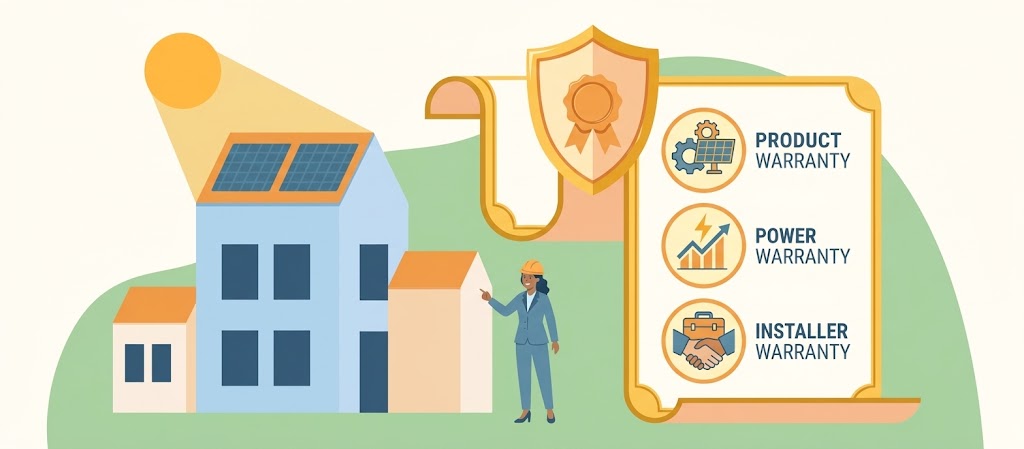
Picture this. You have just collected three solar quotes for your South East home, and on the surface, they look almost identical. Similar panel count, similar inverter, similar bottom-line price. Look a little closer, though, and the warranties tell a very different story: one offers 12 years on the panels, another 25, and the third quietly skips over workmanship cover altogether. A solar PV system is a 25-plus-year investment, so the strength of the warranties behind it matters every bit as much as the kit on the roof. In this guide, we will unpack the three layers of cover (product, performance, and workmanship), explain the extra cover that applies to inverters and batteries, and explore the role of MCS accreditation and Insurance-Backed Guarantees. By the end, you will know exactly what to ask for and what to expect.
What Is a Solar Panel Warranty (and Why It Has Several Layers)
A warranty is, at its simplest, a written promise to repair, replace, or compensate if specified components fail or underperform within a set period. With a UK home solar system, you are rarely covered by a single warranty. Instead, your installation bundles together separate guarantees from the panel manufacturer, the inverter manufacturer, the battery manufacturer (if you have one), and the installer who fitted everything together. A panel may carry a 25-year performance warranty but only a 12-year product warranty, so it is important to compare both.
The rest of this article will explore the three core categories of cover that every homeowner needs to understand:
This layered structure exists for a practical reason. Different parties are responsible for different types of failure. A snapped panel cable due to a manufacturing flaw is the panel maker’s responsibility, while a leaking roof penetration is firmly the installer’s responsibility. Knowing who covers what saves enormous time and stress if anything ever goes wrong.
The Product Warranty: Cover for Manufacturing Defects
The product warranty is issued by the panel manufacturer and covers physical defects in the panel itself. That includes faulty solar cells, internal wiring failures, junction box issues, and glass breakage caused by an internal flaw rather than an outside impact. If a panel develops a hotspot, delaminates, or simply stops producing electricity due to its construction, the warranty pays for a replacement.
Typical UK durations vary by tier. Standard panels usually carry a 12 -15-year product warranty, premium tiers tend to offer 20-25 years, and some of the strongest Tier 1 brands now go as far as 25-30 years. A longer product warranty is one of the most reliable indicators of manufacturer confidence and panel quality, because the company is putting decades of liability behind every module it sells.
One practical tip: keep your proof of purchase and your panel serial numbers in a safe place. A reputable installer will provide a handover pack containing both, along with your inverter and battery details, so you have everything in one place if a claim is ever needed.
The Performance Warranty: Guaranteed Power Output Over 25 Years
While the product warranty covers physical defects, the performance (or power output) warranty covers something more subtle: long-term productivity. It guarantees that a panel will still produce a stated minimum percentage of its rated output after a set period, usually 25 years.
The UK industry norm is roughly 25 years, with standard panels still producing 84 to 88 per cent of their original output at year 25, and premium models holding 90 per cent or more. That difference amounts to thousands of kilowatt hours over the lifetime of your system.
Pay attention to the shape of the degradation curve, too. There are two main approaches:
Understanding this matters because performance directly protects your long-term savings. Every percentage point of lost output is a percentage point of lost bill savings and a smaller export payment under the Smart Export Guarantee (SEG). When you compare quotes, comparing the end-of-warranty output figures is one of the most useful side-by-side checks you can do.
Inverter and Battery Warranties Explained
Inverters are the hardest-working component in any solar PV system. They convert DC electricity from the panels into AC electricity for your home, often running for 10-plus hours a day in summer, every single day. Statistically, they are also the component most likely to need replacement during the system’s lifetime.
Typical UK inverter warranties run from 5 to 12 years as standard, and many manufacturers allow you to extend cover to 15 or 20 years for an additional fee. Premium brands such as SolarEdge and microinverter providers such as Enphase often offer longer cover as standard, which is worth weighing up against the higher upfront cost.
Battery warranties in 2026 typically run 10 to 12 years, but they have an important twist: they almost always include a cycle warranty as well. A common structure guarantees the battery for 10 years or 6,000 to 10,000 charge cycles to 80 per cent retained capacity, whichever comes first. That cycle ceiling matters because heavy daily cycling can reach the cycle limit before the calendar limit.
Two questions worth asking your installer about any inverter or battery warranty:
The Installer Workmanship Warranty and MCS Requirements
The workmanship warranty is the one many homeowners overlook, and it is arguably the most important of the lot. It is provided by the installer, not the manufacturer, and it covers the quality of the actual installation: mounting integrity, roof penetrations, weather sealing, cable runs, and electrical connections.
MCS-certified installers are required to provide workmanship cover under their consumer protection arrangements, although many reputable installers offer significantly longer warranty periods.. That is the floor, not the standard. Reputable UK installers typically offer 5 to 10 years, and the strongest providers extend that to 12, 15, or even 25 years, which is a powerful signal in their installations.
Why does this warranty matter so much? Because it is the one that protects you against roof leaks caused by the installation itself. No panel manufacturer in the world will cover a leak around a mounting bracket, because that is not their fault. If your installer used the wrong flashing or sealed it poorly, the workmanship warranty is what gets the leak put right at no cost to you.
Insurance-Backed Guarantees (IBGs): Your Long-Term Safety Net
There is one obvious weak point in any installer workmanship warranty: it is only as strong as the installer who issued it. If that installer ceases trading five years in, a 10-year written promise on paper is suddenly worth very little.
That is exactly the gap an Insurance-Backed Guarantee (IBG) closes. An IBG is third-party insurance that honours the installer’s workmanship warranty even if the installer goes out of business, so cover continues for the full agreed period regardless of what happens to the original company.
Insurance-Backed Guarantees are typically provided through the installer’s consumer protection arrangements and should be included in the documentation supplied by reputable MCS-certified installers. Any quote without one is a red flag and should make you ask serious questions. They typically mirror the length of the workmanship warranty (often 10 years) and are designed to transfer to subsequent owners if you sell your home, which makes solar a much easier sell to a future buyer.
Ask for a copy of the IBG certificate as part of your handover pack and store it with your other property documents (insurance, EPC, building work paperwork). If a claim is ever needed, that single piece of paper is what keeps you covered.
What’s Not Covered: Common Exclusions and How to Avoid Voiding Cover
Even the strongest warranty has limits, and knowing them in advance prevents nasty surprises later. The most common exclusions are:
Some manufacturers also require evidence of periodic inspections or cleaning to maintain long-term cover. The exact requirements vary, so read the warranty conditions when you receive your handover pack and put any required inspection dates in your calendar.
Two practical steps protect you from accidentally voiding the cover. First, tell your home insurer that you have solar panels and confirm they are listed on your policy (most insurers cover them automatically, but some require a note). Second, keep written records of any maintenance, servicing, or callouts, dated and ideally with photos.
One reassuring point on transferability. Most manufacturer warranties transfer automatically to a new homeowner, and most workmanship warranties do too, provided the new owner notifies the installer within the period specified in the original contract. That makes a well-warranted solar system a genuine added-value feature when you come to sell.
How to Make a Solar Warranty Claim, Step by Step
If something does go wrong, a calm, methodical approach gets you back up and running fastest. Here is the route most UK warranty claims follow:
FAQs
Do solar panel warranties transfer to a new homeowner if I sell my house?
Yes, in almost all cases. Manufacturer product and performance warranties transfer automatically to the new owner because they are tied to the panels and serial numbers rather than the original buyer. Workmanship warranties and Insurance-Backed Guarantees usually transfer too, provided the new owner notifies the installer or IBG provider within the period set out in the original paperwork. Always pass on the handover pack (invoices, MCS certificate, IBG certificate, serial numbers) when you sell, and your buyer inherits the full benefit of the system. This is why a well-warranted solar installation is one of the easiest property upgrades to monetise at the time of sale.
What happens to my warranty if the installer goes out of business?
Your panel, inverter, and battery product warranties are unaffected because they are issued by the manufacturers, not the installer. The risk lies with the workmanship warranty, which is the installer’s own promise. That is precisely why MCS-certified installers must provide an Insurance-Backed Guarantee. The IBG steps in as a third-party insurer to honour the workmanship cover for the full agreed period (often 10 years), even if the original company has stopped trading. Always ask to see the IBG certificate before signing your contract, and keep it with your home documents.
Does my home insurance need to know I have solar panels?
Yes, you should always inform your home insurer. Most UK insurers will cover roof-mounted solar panels under your standard buildings policy at no extra cost, but some require a written note on the policy schedule, and a few will only cover panels if the installation was carried out by an MCS-accredited installer. Manufacturer and workmanship warranties cover defects and installation issues, not storm or accidental damage, so home insurance is what protects you against the rest. It is worth informing your insurer as soon as the installation is commissioned..
Can I extend my inverter or battery warranty after installation?
Often yes. Most inverter manufacturers offer paid warranty extensions, typically extending the standard 10-year cover up to 15 or 20 years. Some allow this only at the point of purchase, while others provide a window during the original warranty period. Battery warranty extensions are less common because the cover already runs to 10 to 12 years as standard, with a cycle limit in parallel. The best time to consider an extension is when you place the order, because that is when discounts are available, and paperwork is simplest. Ask your installer to quote standard and extended cover side by side.
Is a longer warranty always a sign of a better panel?
Usually yes, but not always. A 25 or 30-year product warranty is a strong signal of the manufacturer’s confidence, because the company is committing to decades of liability. However, the warranty is only as good as the company behind it, so always check that the manufacturer has a long UK trading history and a robust local service network. A 30-year warranty from a brand that exits the UK market in five years has very little real-world value. Compare the warranty length, the end-of-warranty output percentage, the brand’s UK service presence, and independent reliability data together for the best picture.
Conclusion
Strong warranties are what turn a solar quote into long-term peace of mind. Over the lifetime of a UK home solar installation, three layers of protection sit behind the installation: the product warranty for manufacturing defects, the performance warranty for guaranteed output, and the workmanship warranty for the quality of the install itself. Add to that the extended cover that protects your inverter and battery, the safety net of MCS accreditation and an Insurance-Backed Guarantee, and you have a system that is genuinely protected for the decades it is expected to run.
The installer you choose matters every bit as much as the panels on your roof. At The Solar Co, we are fully MCS-accredited, we provide a transparent written warranty pack with every installation, and every system comes with an Insurance-Backed Guarantee, so your investment is protected even if circumstances change. If you are comparing quotes and want to see exactly what your warranty cover would look like with us, book a free home survey today.
Back to Blog