
Energy Savings Calculator
0203 193 8888


0203 193 8888
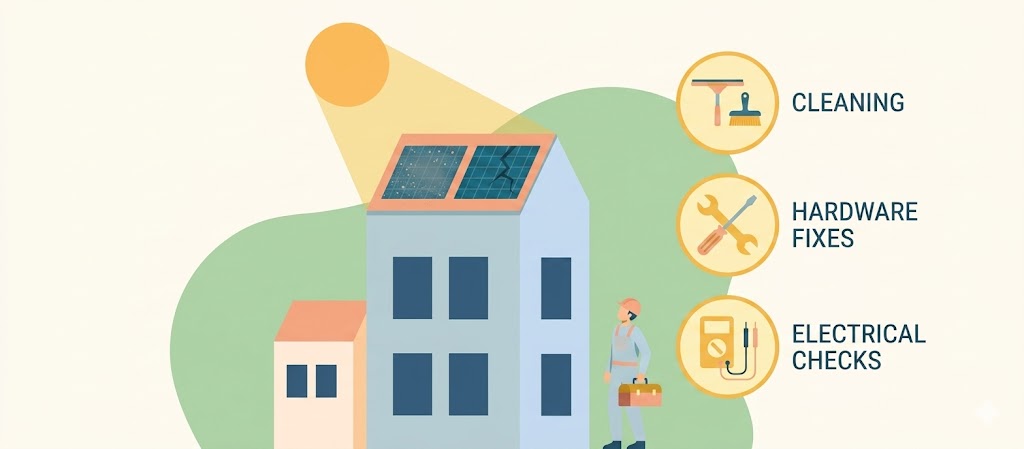
Solar panels are among the most reliable home technologies available. Built to last 25 years or more with minimal intervention, a well-installed system will quietly generate electricity through rain, wind, and shine without demanding much attention. That reliability, however, does not mean solar panels are entirely immune to faults. Surveys suggest that most solar owners experience few or no significant problems during the lifetime of their system. But for those who do encounter an issue, knowing what to look for can make the difference between a quick fix and costly damage. This guide covers the six most common solar panel problems UK homeowners face, what causes them, and when to call in a professional rather than investigate further yourself.
The solar inverter is the workhorse of any PV system, converting the direct current (DC) generated by the panels into the alternating current (AC) your home uses. While quality solar panels are routinely guaranteed for 25 years, inverters typically have a lifespan of 10 to 15 years, making them the component most likely to need attention or replacement during the life of your system.
Warning signs of a solar panel inverter fault are usually visible on the unit itself or through your monitoring app. Look out for error codes or fault messages on the display, flashing or red indicator lights, a blank or unresponsive screen, or a significant and unexplained drop in output that does not correspond to poor weather. Some fault codes, particularly those related to grid disconnection or temporary communication errors, can be cleared by restarting the system following the manufacturer’s guidance. Persistent errors that return after a restart, or any physical signs such as scorch marks around the casing, a burning smell, or an unusual buzzing sound, are urgent warning signs requiring professional attention.
Inverters contain high-voltage DC and AC electricity at all times and must never be opened or internally inspected by an untrained individual. Contact an MCS-accredited solar engineer for any inverter fault you cannot resolve through a restart.
A gradual or sudden drop in energy generation is the most commonly reported issue for solar panels not working as expected, and the good news is that it often has a straightforward explanation. Working through the most likely causes in order of simplicity will usually identify the problem before a professional call-out is necessary.
The most common and easily remedied cause of reduced solar panel output is soiling. Dirt, bird droppings, moss, lichen, and general grime accumulate on panel surfaces over time, reducing the amount of sunlight reaching the photovoltaic cells. Even partial coverage on a single panel can have a disproportionate effect on overall system output, particularly in string inverter setups where panels are wired in series. In some cases, professional cleaning may restore output where dirt or bird fouling has accumulated..
Shading from new obstructions is another common cause, particularly in the suburban and semi-rural settings typical across South East England. Growing trees, new garden structures, roof extensions on neighbouring properties, or changes to satellite dishes and aerials can all introduce shading that was not present when the system was installed. Even partial shading for a few hours a day can noticeably reduce overall generation.
Natural panel degradation is also worth considering for older systems. Most quality panels lose around 0.5 to 1 per cent of their efficiency per year. A significant unexplained drop below this rate in a system that is more than five years old may indicate a deeper underlying fault. For many homeowners, the monitoring app provides the first indication of a developing fault long before it becomes visible on the roof. With the app, compare your current output against the same period in previous years on similar weather days. A consistent shortfall is a reliable indicator that something requires attention.
Hot spots are one of the more serious solar panel problems precisely because they are invisible to the naked eye. They occur when a single cell or group of cells within a panel is shaded, damaged, or soiled while the rest of the panel continues to generate electricity normally. In a series-wired string circuit, those faulty cells are forced to absorb power from the rest of the panel rather than produce it, causing them to heat up significantly.
Because hot spots cannot be detected by looking at a panel’s surface, they often go unnoticed for months or even years. A monitoring app may flag consistent underperformance in a particular section of the array, but without thermal imaging equipment, it is impossible to accurately identify the affected cells. Professional thermal imaging surveys, widely available from qualified solar engineers, can pinpoint hot spots quickly and determine their likely cause.
Left untreated, hot spots cause irreversible damage to affected cells and permanently reduce the panel’s output capacity. In serious cases, the sustained heat generated can increase the risk of further damage and, in severe cases, pose a fire safety concern, particularly where the rear of the array is in close contact with roofing materials. If your system is consistently underperforming on clear sunny days and a cleaning has not resolved the issue, a thermal imaging inspection is the most reliable next step, particularly for systems more than five years old or those that have experienced physical damage from hail or falling debris.
The gap between a solar array and the roof surface provides exactly the kind of warm, sheltered, elevated space that pigeons and other birds find attractive for nesting. This is a growing problem across South East England, where urban and suburban pigeon populations are high, and the widespread adoption of residential solar has created numerous potential nesting sites.
The consequences of bird activity beneath a solar array go well beyond visible fouling. Accumulated droppings and nesting debris reduce panel output and can block drainage channels, trapping moisture against the roof. The more serious concern is animal damage to DC cabling. Rodents will chew through insulated cabling given the opportunity, and a compromised DC cable poses an electrical safety hazard requiring urgent professional attention rather than a cosmetic repair.
If you notice birds regularly gathering on or around your array, hear activity beneath the panels, or observe fouling on your roof or gutters that was not present before installation, it is worth arranging an inspection. Professionally fitted bird-proofing mesh or skirting, installed around the perimeter of the array, prevents access entirely and is typically a one-off cost. The same barrier also keeps the underside of the panels cleaner and protects cabling from other environmental debris.
Solar PV wiring faults are among the less visible but more hazardous problems a solar system can develop. They are most commonly caused by corrosion in outdoor connectors, degraded or loose MC4 plug connections, poor terminations during installation, or physical damage to cabling from animal activity or subsequent roof work.
The symptoms are not always obvious. An unexplained drop in output not attributable to weather or soiling is one indicator, particularly if it affects only part of the array. Tripped breakers at the consumer unit or the inverter’s AC disconnect are another. Inverter error codes relating to string isolation, insulation resistance failure, or earth faults are serious warnings that a wiring fault may be present and should never be dismissed without investigation.
Arc faults are the greatest risk associated with degraded wiring. When a loose or corroded connector creates an intermittent connection under load, the resulting electrical arc generates intense, localised heat. Solar PV systems are generally very safe, but any suspected wiring fault should be treated seriously. The risk is real enough that any suspected wiring fault should be treated as urgent, regardless of how minor the visible symptoms appear.
All DC wiring in a solar PV system carries high voltage whenever the panels are exposed to daylight, including when the inverter has been switched off at the AC side. Inspection and repair must only be carried out by a qualified solar PV electrician.
Some forms of solar panel degradation are too gradual or too microscopic to detect without specialist equipment, but their cumulative effect on system performance can be significant. Two of the most common causes of long-term decline in older systems are Potential Induced Degradation (PID) and microcracks.
PID is a voltage-driven effect that causes cells within a panel to progressively lose power output. It tends to affect panels at the edges of a string most severely and can result in losses of 20 per cent or more in advanced cases. PID is more commonly associated with older panel technologies and lower-quality modules, but it can affect any system in which voltage stress interacts with panel materials under specific humidity or temperature conditions.
Microcracks are hairline fractures in the crystalline silicon cells of a panel, too small to see with the naked eye. They are caused by physical stress, which can include hail or heavy snow loading, mishandling during original installation, or the gradual thermal expansion and contraction cycles that all panels undergo over many years. A panel with minor microcracks can continue to generate electricity, but the cracks tend to expand over time and eventually cause cell circuit interruptions that measurably reduce output.
Both conditions worsen progressively. If your system is 10 or more years old and experiencing performance decline that cannot be explained by soiling, shading, or weather, a professional health check is the most sensible course of action. The cost of replacement panels has dropped considerably in recent years, and replacing a degraded module may now be more cost-effective than accepting continued output loss.
Some solar panel problems can be safely investigated and resolved by a homeowner. Others require a qualified solar panel engineer and should not be delayed. Knowing the difference is the most important takeaway from this guide.
The situations that always require professional attention include:
The actions a homeowner can safely carry out themselves include:
Older systems, particularly those showing signs of reduced performance, may benefit from a professional inspection. A qualified engineer can carry out a full visual inspection, check all connection points, test inverter performance, review monitoring data, and identify early-stage faults before they become more serious or expensive to address. For homeowners who are uncertain about the cause of a performance drop, a professional assessment from an MCS-accredited installer is almost always worth arranging sooner rather than later.
If your solar panels are producing no electricity at all, the most likely cause is an inverter fault or a tripped circuit breaker. Start by checking the inverter display for error codes and confirming that the AC disconnect and any associated breakers at the consumer unit are in the correct position. A system restart following the manufacturer’s guidance will resolve some fault conditions, but if the inverter remains unresponsive or returns the same error, contact an MCS-accredited engineer rather than attempting any internal investigation yourself.
Common signs of an inverter fault include error codes or flashing indicator lights on the display, a blank or unresponsive screen, or a persistent drop in output that is not explained by weather. Some minor errors can be resolved with a restart, but persistent fault codes, physical signs such as scorch marks or a burning smell, or unusual buzzing from the unit all indicate a problem requiring professional inspection. Inverters typically last 10 to 15 years, so older units are more susceptible to failure.
A small number of issues are safe for a homeowner to address: cleaning panels from ground level, restarting the inverter following the manufacturer’s instructions, and checking the monitoring app data. Any work involving the inverter, DC wiring, connectors, or roof-mounted hardware must be carried out by a qualified solar PV electrician. DC cabling carries high voltage whenever daylight is present, even when the inverter appears switched off. When in doubt, call a professional.
Most installers recommend a professional inspection every three to five years for a well-performing system, and more frequently for systems over 10 years old. In practice, many homeowners do not arrange an inspection unless they notice a problem, which is why faults such as hot spots and early-stage PID can go undetected for years. A professional health check typically covers a full visual inspection, electrical testing, inverter diagnostics, and a review of monitoring data, and usually takes only a few hours.
Most solar panels come with a product warranty covering manufacturing defects, typically between 12 and 25 years, depending on the manufacturer and product tier, alongside a performance warranty guaranteeing a minimum output level for 25 years. Inverters usually carry a 5 to 10-year manufacturer’s warranty. Physical damage from external causes such as hail or animal activity is generally not covered by a product warranty, though it may be covered by your home building insurance. If you suspect a warranty fault, contact your original installer with your system documentation.
Solar panels are designed to be low-maintenance and are genuinely one of the most durable technologies you can install on a home. The six problems covered in this guide are among the most common issues, from inverter faults and reduced output to hot spots, bird damage, wiring faults, and long-term degradation, and account for the vast majority of solar panel problems UK homeowners encounter over the life of a system. Most are manageable when identified early, and the guiding principle that runs throughout this guide is the same: anything involving electrical components, wiring, or the inverter should be left entirely to a qualified professional.
If you have noticed a drop in output, received an error from your inverter, spotted physical damage, or simply want peace of mind about your system’s condition, The Solar Co can help. We are an MCS-accredited installer based in the South East of England, experienced in diagnosing and repairing solar PV systems of all ages and configurations. Our engineers can carry out a full health check, identify any faults, and provide a clear and honest assessment of your options.
Back to Blog