
Energy Savings Calculator
0203 193 8888


0203 193 8888
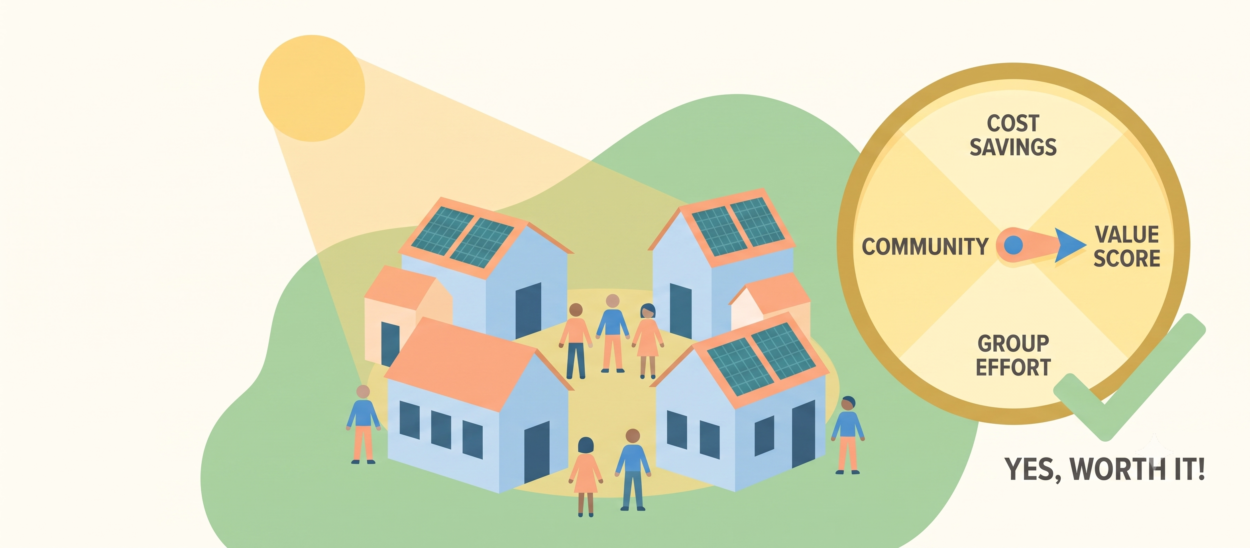
The upfront cost of solar is one of the most common reasons UK homeowners put off going green. So when a letter arrives from your local council inviting you to join a group-buying scheme, the appeal is obvious. Solar Together has been operating in the UK since 2012 and is now available through dozens of councils, offering bulk-discount pricing through a process called a reverse auction. The headline figures, often 20 to 30 per cent below average market rates, sound compelling. But do those savings genuinely stack up once you examine at equipment quality, installer choice, lead times and aftercare? This guide breaks down exactly how the scheme works so you can make a confident, informed decision.
Solar Together is a council-backed group-buying initiative delivered by the Dutch company iChoosr. The model is straightforward: a local authority promotes the scheme to its residents, while iChoosr manages the registration process, vets installers and runs the auction that determines pricing.
It is important to be clear about what the scheme is not. Solar Together is not a government grant, and it does not provide free solar panels. Homeowners who take part still pay for their installation in full; they simply benefit from a bulk-negotiated price. The scheme has grown steadily since its launch, with thousands of UK homes now installed through it and new council areas joining each year across England and Wales.
Eligibility is broadly straightforward: the scheme is open to homeowners or, in some cases, leaseholders with landlord permission. Certain council rounds also include small businesses and Commonhold Associations.
The process follows five typical stages, and understanding each one helps set realistic expectations.
One important caveat on timing: from initial registration through to the moment your system is switched on, the full journey can take around nine months in many regions. In some cases, homeowners have reported waiting longer than twelve months. If you need panels installed by a specific date, this lead time is worth factoring in from the outset.
Solar Together and the Greater London Authority cite typical savings of 20 to 30 per cent off average market rates, with some councils reporting figures of 35 to 40 per cent in their published round reports. Those headline numbers are attractive, but they come with caveats worth unpacking.
The comparison point is an unspecified national average rather than prices from local, directly contracted installers. In practice, if you gather three quotes from MCS-certified installers in your county, you may find that at least one comes close to, or even matches, the Solar Together price. To give a rough sense of scale: a typical 4 kW system in the South East might be quoted at somewhere between £6,000 and £8,000 through a direct installer, depending on equipment choice, while a Solar Together offer for a comparable system might land towards the lower end of that range or slightly below it. That is a difference, but not always as dramatic as the headline percentage implies.
It is also worth noting that 0% VAT on domestic solar panels applies to all UK installations regardless of how you procure them, so this is not an exclusive advantage of the scheme. Where pricing differences between group-buying and independent quotes tend to be most significant is on battery storage. This typically adds several thousand pounds to the total and is where installer margins vary most.
Group-buying schemes have a good track record, but they also come with limitations that are less frequently highlighted in council promotional material.
The most practical advice for any homeowner considering Solar Together is to treat it as one quote among several. Even if the process takes a few more hours, gathering at least two quotes from MCS-certified local installers gives you a genuine comparison.
When comparing, look beyond the headline price and examine:
It is also worth asking each installer for examples of nearby installs, ideally with homeowners willing to provide a reference, and checking their reviews on independent platforms such as Trustpilot or Which? Trusted Traders.
Solar Together runs in defined geographic rounds linked to participating councils. Not every council area is part of the scheme, and those that are tend to open registration windows for limited periods before each auction round. Missing the registration window can mean waiting for the next one, which could be six to twelve months away.
To find out if a round is active near you, check your local council’s website or visit the official Solar Together site. Several South East councils, including areas within Kent, Sussex and Surrey, have run rounds in recent years. Some councils now also run alternative or complementary group-buying pilots, sometimes under different names, so it is worth checking your council’s energy or sustainability pages for the latest information.
Solar Together works well for some homeowners and less well for others. Being honest about which group you fall into can save a lot of frustration.
Group-buying is likely a good fit if you:
Group-buying is probably a poor fit if you:
No. Solar Together is a council-promoted group-buying initiative, not a government grant. Homeowners who accept an offer pay for the full cost of their installation. The benefit is a bulk-negotiated discount through a competitive auction, not subsidised or free panels. Separate government support mechanisms, such as the Smart Export Guarantee, remain available to all eligible installations regardless of how they are procured.
Published figures from iChoosr and participating councils typically cite 20 to 30 per cent below average market rates, with some rounds reporting higher. However, the comparison is against a national average rather than local quotes. In practice, getting two or three quotes from MCS-certified installers in your county may produce prices close to the group-buying figure, particularly if the local market is competitive. The savings are real but not guaranteed to be dramatic in every case.
Generally, no. Once an installer wins the regional auction, they specify the equipment package for all accepted households. You can accept or decline the offer, but you cannot negotiate the panel brand, inverter model or battery chemistry within the scheme. If equipment specification matters to you, an independent quote lets you compare specific products and warranties side by side.
This is a genuine risk with any single-contractor model. iChoosr does pre-vet installers, and some council agreements include provisions for alternative arrangements, but the level of protection varies by round. As a homeowner, it is worth asking iChoosr directly what consumer protections are in place before accepting an offer, and whether the installer holds appropriate insurance for part-completed works.
Yes. The Smart Export Guarantee is available to any eligible solar PV system installed by an MCS-certified installer, regardless of how you sourced the installation. Solar Together’s pre-vetted installers hold MCS certification, so a system installed through the scheme should qualify. Once your system is live, you apply directly to an energy supplier who offers a SEG tariff to begin receiving payments for the electricity you export to the grid.
Solar Together can be a useful route for UK homeowners who want a bulk-negotiated price without the effort of sourcing multiple quotes. The savings are real. The process is straightforward, and local council endorsement adds a layer of reassurance. The scheme is not automatically the cheapest or the best option for every household. Equipment specifications, installer choice and installation timelines are all constrained by the auction model in ways that matter more to some homeowners than others.
The smartest approach is to use a Solar Together offer as one data point alongside two or three independent quotes from MCS-certified local installers. Compare on specification, not just price, and factor in how long you are prepared to wait.
If you are based in the South East and would like a free, no-obligation quote to set alongside any group-buying offer, The Solar Co would be happy to help. We offer full transparency on panel and inverter brands, lead times and aftercare, so you can weigh a bespoke proposal against the group-buying route with confidence.
Back to Blog