
Energy Savings Calculator
0203 193 8888


0203 193 8888
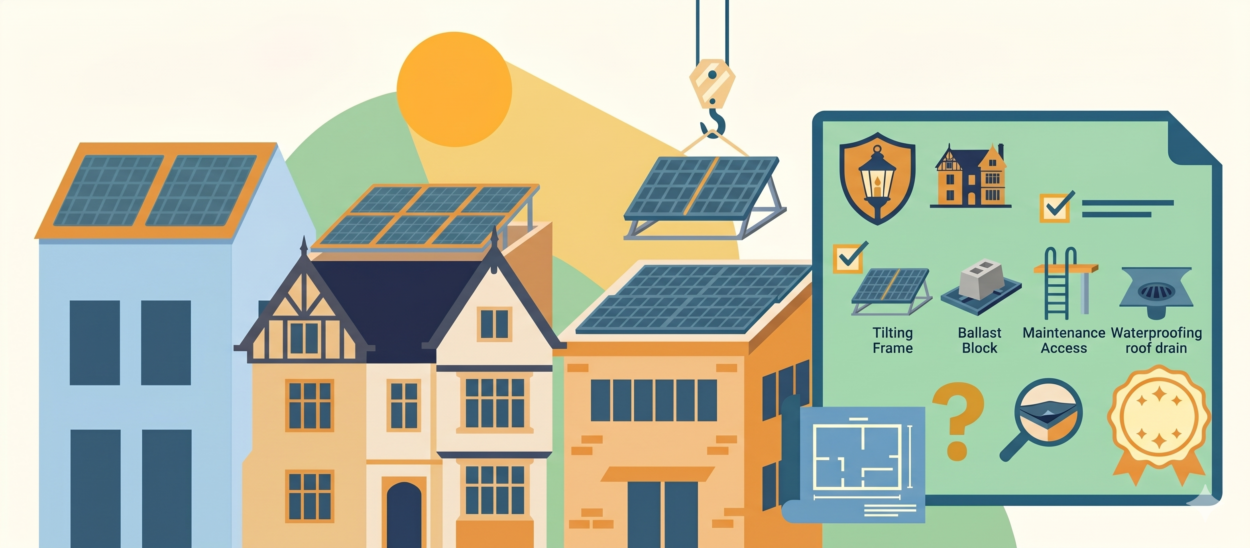
There are real advantages to having a solar system installed on your flat roof in the South East of England. On a flat roof, they can be oriented flexibly towards the Sun. They can face both east and west if on a suitable roof, and can offer easier access for maintenance. Finally, you can hide them from the street’s view – an advantage, where it comes to conservation areas or listed buildings.
There are some genuine concerns you may have, including leaks, weight, wind and weather and whether their orientation can generate sufficient power for the investment. In this guide, we will allay these concerns by providing a jargon-free walkthrough of the challenges and proven solutions known to MCS-certified installers that can address most of them.
Yes, many homes with flat roofs across the UK can have solar arrays installed on them – particularly on modern homes, extensions and garages in the South East.
Because they require drainage, ‘flat’ roofs are rarely truly flat and will have a 1-5º gradient to ensure this. It has minimal impact on system design, but installers will still account for drainage and roof fall during layout planning.
The survey will focus on the biggest issues – the roof covering and its current condition, not just the pitch. We will look at this and the permitted development amendment in 2023, which allows the solar array to protrude above the roof’s highest point, later in the article.
Flat roof solar installations have certain issues that differ from pitched roofs, including:
An MCS-certified installer will account for these in the detailed site survey to determine the best solution for your property.
The most common choice for UK flat roof solar arrays is the ballasted system that requires no penetration through the membrane. In this case, tilt frames sit on protective pads that are in turn weighed down with concrete ballast blocks.These can weigh 15-30kg per square metre distributed across the structure, and as a result, the surveyor must assess roof strength and rigidity before work begins.
The alternative approach is the penetrating system where the frames are bolted through the membrane into the structural deck. To ensure weatherproofing, installers use EPDM-compatible flashing, but this carries a small risk of failure, so installers typically use it where ballast weight is impractical or wind exposure is severe.
A third way forward is where a small number of fixings and a reduced ballast load is used in a hybrid system. This is common where the roof has been partially reinforced for extra loads.
Finally, where the roof plane runs east-west, panels can be arranged in V-shaped pairs, with alternate panels facing east and west. This improves the aerodynamics and can cut the amount of ballast required as a result. It also allows you to fit more panels into the same footprint than a pure south-facing layout.
There is no absolute answer to this question as the array is specific to your flat roof. Solar yield, available roof area, ballast limits, and aesthetics all have an impact on the final solution. The angle of your flat roof may differ from that of a neighbour’s with a similar flat roof. Additionally, though shading can be an issue, you can achieve higher power density by fitting more panels per square metre.
The best angle for a solar panel array in the UK is 30-35º. It isn’t always possible with flat roofs because of wind loading. Additionally, the wider gaps required between rows can cause panel-on-panel shading. As a result, an installer will often choose a compromise tilt of 10-15º.
The lesser tilt can impact generation potential with losses of 5-10% from an optimal angle. One option is the east-west V tilt we touched on earlier – this creates a flatter daily generation curve, with higher average generation in the morning and afternoon. This can be useful for you if you aren’t having a battery installed.
The surveyor will assess the roof covering as a first step. Where a roof covering is nearing the end of its useful life (of 20-25 years for felt and 25-50 years for EPDM), it should be replaced before the team installs the panels.
The best roof membrane for a ballasted system is EPDM rubber and single-ply membranes. These membranes tolerate the weight of mounting arrays on protective slip pads without failing under the load.
It is also possible to install ballasted systems on felt and asphalt membranes. However, the surveyor will need to assess it for blistering, cracking, or seam failures before installing the panels on them.
If it is impossible to install a ballasted system, the team will use a penetrating fixing system. In this case, the installers will use bonded EPDM flashings or proprietary sealing kits to maintain the membrane warranty.
Whatever the solution the installer decides on, you should ask them for written confirmation that the mounting method they suggest preserves any existing roof warranty.
Most modern roofs can handle the extra weight of a ballasted solar array, which weighs about 15-30kg per square metre. That would mean that, if you have had a new extension added to your home in the last 10 years, it will probably take that weight. Regardless of the theory, there will be a structural survey of the roof that will include:
In some circumstances, the solar installation company will contract a chartered structural engineer to conduct a more thorough assessment of the roof’s existing strength. This might be the case if the proposed ballast loading is high or if the surveyor cannot determine the roof’s age. Common cases where an engineer is called in can be:
In such cases, the team may determine that reinforcement is needed. The cheapest solution may be adding noggins, which are shorter pieces of wood placed between the joists to improve load-bearing capacity, stiffness, and prevent the deck from twisting. More expensive alterations include adding new joists to reduce the deck flexing and, finally, replacing the deck and, if structurally unsound, the membrane.
Surveyors will always make more conservative judgements in these cases as a roof failure is catastrophic. The Solar Co will advise you if any remedial work like this is required before engaging in the solar panel installation, so there will be no unexpected costs.
In another guide, we look at planning permission for solar panels. Since 2023, homeowners have been allowed to install solar systems on flat roofs under ‘permitted development’ rules, subject to certain conditions. You don’t need planning permission if the panels do not protrude more than 60cm above the roof surface (to minimise visual impact), and they must sit below the highest part of the roof (excluding chimneys). It is also one of the reasons solar arrays on flat roofs tend to sit at a less-than-ideal pitch.
You will still need planning permission if:
It can be helpful to know where you stand with planning permission. If you are unsure, contact your local authority for written advice. It can avoid problems down the line, for example, should you sell the home.
A flat roof install can typically cost £500-£1,500 more than one on a pitched roof, meaning that a 4kWp array can cost £6,500-£9,500 (2025/26 prices) fully installed. If you add a battery, this can cost around £10,000-£12,000. The added costs come from tilt frames, ballast and a more detailed structural assessment.
You should get at least three quotes before deciding which solar installer to work with. Before installation, ensure you obtain a written quotation from an installer that covers mounting hardware, ballast and any roofing repair/remediation separately. It will mean that you can compare the three or so quotes you get like-for-like.
One of the better flat roof layouts is the east-west V arrangement. As we touched on earlier, it requires less ballast and can increase the number of panels in a given space. It can mean you achieve a higher power output for the given space, and ultimately use less grid energy, resulting in greater long-term savings.
When it comes to long-term savings, remember that until 2027, solar panels and batteries are VAT-exempt. Additionally, if you choose an MCS-certified installer, you will qualify for the Smart Export Guarantee (SEG) that enables you to sell excess electricity to the grid. There are also some grants available to install solar panels.
No — when installed correctly, solar panels should not damage a flat roof. Most systems use weighted mounting frames that sit on the surface rather than penetrating it. Warranty impact depends on the roofing manufacturer, so it’s always worth checking, but reputable installers work within approved methods to avoid issues.
Yes — EPDM roofs are well-suited to non-penetrative systems. Installers typically use ballasted mounting frames that are weighed down to keep the system secure without fixing into the roof membrane. This helps maintain waterproofing while still providing a stable installation.
In many cases, you won’t generate less — and may even generate more. Flat roof systems can be mounted at an optimal angle (typically 10–15° in the UK), which can improve performance compared to suboptimal pitched roofs. The main trade-off is spacing between panels to avoid shading, which can limit how many you can install.
Not significantly. Like any solar system, panels benefit from occasional cleaning, especially if dirt or debris builds up. Flat roofs can accumulate more dust or standing water, so periodic checks are sensible, but overall maintenance requirements are similar to pitched roof systems.
Yes — solar panels can be removed and reinstalled if roof work is needed. It is a relatively straightforward process for installers, but it does add cost. If your roof is nearing the end of its lifespan, it’s usually more cost-effective to replace it before installing solar.
Flat roofs are well-suited for solar systems, provided they are designed and completed correctly by MCS-certified professionals. A job done well from start to finish will include:
The Solar Co is the South East England specialist that handles every type of flat roof in-house, from structural survey to MCS-certified installation. Book a free flat-roof feasibility assessment with us, where we will inspect the roof, model the expected output, and provide a free, no-obligation written quote.
Back to Blog