
Energy Savings Calculator
0203 193 8888


0203 193 8888
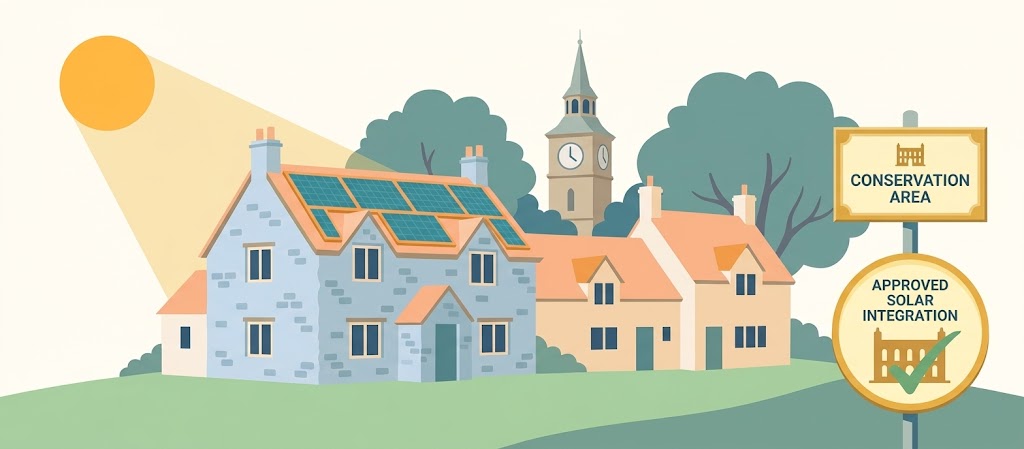
If you live in a conservation area, it is natural to assume solar panels are off the table, buried under layers of planning red tape, or simply not worth the hassle. The good news is that this worry is usually unfounded. The great majority of homes in conservation areas can install solar panels under permitted development, without needing full planning permission at all. This guide sets out exactly what the rules say: when permitted development applies, when you will need to apply for planning permission, what an Article 4 Direction means for your street, and how to design an installation that respects your property’s character while still delivering real energy savings. This article explains the permitted development rules that apply in England; different planning regimes operate in Scotland, Wales and Northern Ireland.
What Is a Conservation Area, and Does It Affect Solar Panels?
A conservation area is a part of England designated by the local planning authority for its special architectural or historic character, one that the council wants to preserve or enhance. Designation does not freeze a neighbourhood in time or ban homeowners from making changes. It exists to manage change sensitively, not to prevent it.
There are over 11,300 conservation areas in England, covering everything from historic market towns to Victorian suburbs, so this is a genuine consideration for a significant number of UK homeowners, including many across the South East. If your home falls within one, it is worth understanding what that designation actually restricts before assuming solar is off the table.
The key point to hold onto is this: conservation area status restricts certain types of external works and adds some additional planning considerations, but it does not prohibit solar panels outright. Most homeowners in a conservation area can still go solar, provided the installation is designed with the area’s character in mind.
It is also worth being clear that a conservation area is a distinct designation from a listed building. The two are often confused, but they carry different rules, and a listed building within a conservation area is subject to a stricter, separate consent process, which we cover later in this guide.
Permitted Development Rights for Solar Panels in Conservation Areas
For most homeowners, the reassuring news is that roof-mounted solar installations still qualify as permitted development even within a conservation area, meaning no planning application is required, provided the installation meets a specific set of conditions.
These conditions are designed to keep solar installations discreet and in keeping with the property, rather than to make solar difficult to achieve. Most well-planned residential installations comfortably meet all three.
That said, interpretation of these rules can vary between local authorities, and some councils take a more cautious approach than others in sensitive conservation areas. Before starting any work, it is always worth checking directly with your local planning authority to confirm your specific position, particularly if your roofline, property type, or street is unusual. A quick call or online enquiry can save considerable time and give you confidence before committing to a design.
When You Will Need Planning Permission
Although many roof-mounted installations qualify as permitted development, planning permission or prior approval may still be required in particular circumstances. The main issues are the location and form of the installation, whether the property is listed and whether an Article 4 Direction affects the address.
Panels fitted to a wall that fronts a highway normally require planning permission in a conservation area. Roof-mounted panels, including those on a roof slope facing a highway, can still qualify as permitted development if they comply with the relevant projection, height and visual-impact conditions. However, an Article 4 Direction may remove those rights for particular properties or elevations.
Solar panels on a flat roof in a conservation area can still be permitted development, but the homeowner must normally apply to the local planning authority for prior approval. This is a more limited process than a full planning application and allows the council to assess the proposed design and external appearance. The equipment must also remain within the applicable 60cm projection limit.
Ground-mounted solar equipment has its own permitted-development limits covering its size, height and position. Planning permission may be required where an array exceeds those limits, is installed within the curtilage of a listed building or scheduled monument, or is affected by an Article 4 Direction. Public visibility may influence the council’s decision where an application is required, but visibility alone does not automatically remove permitted development rights.
It is also worth noting that panels fitted to a separate building within the grounds, such as a garage or outbuilding, may be subject to different rules to those applied to the main house. If your plans include outbuildings as well as your primary roof, it is worth checking each structure’s position separately rather than assuming the same rules apply throughout the property.
Article 4 Directions: When Permitted Development Is Removed
An Article 4 Direction is a planning tool that allows a council to remove specified permitted development rights from particular properties or areas. If the direction covers the relevant type of roof or external alteration, a solar installation that would normally be permitted development may require planning permission instead.
Councils use Article 4 Directions in areas they consider especially vulnerable to incremental change, often historic town centres, well-preserved Georgian or Victorian streets, or areas with a particularly consistent architectural character worth protecting closely.
Because an A4D can apply to an individual street or even a small group of properties rather than an entire conservation area, it is essential to check whether one applies to your specific address rather than assuming your neighbourhood-wide status tells the whole story. The most reliable way to check is to contact your local planning authority directly, or to search your council’s online planning portal, where Article 4 Directions are usually listed alongside conservation area boundaries.
Installing panels without the necessary permission can lead to enforcement action, including a requirement to alter or remove the installation at the homeowner’s expense. Checking the address before finalising the design avoids that risk.
Listed Buildings vs Conservation Areas: Know the Difference
It is a common misconception that being in a conservation area automatically means a property is listed. In fact, the two designations are separate, and many conservation areas contain a mix of listed and unlisted buildings.
Listed building consent is a distinct, and generally stricter, process than the planning rules that apply to conservation areas more broadly. Where a conservation area designation manages change with an eye on the street scene as a whole, listed building status protects the specific architectural or historic interest of an individual property, inside and out. Solar panels on a listed building will normally require listed building consent because they affect its external appearance and may involve alterations to historic fabric. Planning permission may also be required separately, including for solar equipment installed within the listed building’s curtilage.
Homeowners with a listed property should expect additional conditions on top of standard planning considerations. A successful design will usually seek to minimise permanent alteration to historic fabric. The council may also examine the location of panels, brackets, cabling, inverters and meter equipment, with discreet and reversible solutions generally preferred.
If you are unsure which category your home falls into, this is worth clarifying early. Your property could be in a conservation area, be individually listed, or both, and each combination changes what process you need to follow before installing solar panels.
Designing a Sensitive Solar Installation
Good design goes a long way towards a smooth planning outcome and a result that respects your property’s character. A few principles consistently make the difference in conservation area projects:
Sensitive design does not necessarily prevent a strong-performing system, but appearance and generation sometimes need to be balanced. An experienced installer can model the output from different roof slopes and panel layouts, helping the homeowner choose a design that remains commercially worthwhile while reducing its visual impact.
How to Check Your Local Rules and Apply for Permission
The national Planning Portal is a useful starting point for understanding the general permitted development rules. For property-specific restrictions, including Article 4 Directions, contact the local planning authority or check the council’s conservation-area pages and interactive planning maps.
Many councils also offer pre-application advice services specifically for conservation area projects. While these often carry a modest fee, they can be well worth it, giving you an informed steer on your likely planning position before you invest in a full design or commit to purchasing equipment.
Where planning permission is required, allow for the nationally prescribed application fee and any separate charges for professional drawings or planning support. Councils normally aim to determine a straightforward householder application within eight weeks, although requests for further information, heritage issues or objections can extend the process. Listed building consent itself does not carry an application fee, although preparing the necessary supporting material may involve professional costs.
A professional installer who is experienced in conservation area projects will usually handle much of this process on your behalf, from confirming your permitted development position to preparing and submitting a planning application where one is genuinely needed, taking a significant administrative burden off your shoulders.
Working with an Experienced Installer in a Conservation Area
Choosing an MCS-certified installer who understands heritage and conservation area sensitivities makes a real difference to how smoothly a planning-sensitive project runs. Beyond technical competence, this kind of experience means knowing which design choices are likely to satisfy a cautious planning officer and which are likely to invite additional scrutiny.
At The Solar Co, we manage planning checks and council liaison as a standard part of our installation process for conservation area properties, confirming your permitted development position early and handling any necessary applications on your behalf where full planning permission is required.
The best way to get a clear, tailored assessment of your options is a free site survey, where we look at your roof orientation, visibility from the street and surrounding area, and the design choices most likely to deliver a compliant, sensitive installation for your specific property.
FAQs
Do I need planning permission for solar panels in a conservation area?
In many cases, no. Roof-mounted solar panels in an English conservation area can still qualify as permitted development if they comply with the relevant projection, height and visual-impact conditions. Panels fitted to a wall fronting a highway normally require planning permission, while flat-roof installations may require prior approval. An Article 4 Direction or listed status can introduce additional requirements, so the property’s individual position should always be checked before work begins.
What is an Article 4 Direction and how do I find out if it applies to my home?
An Article 4 Direction is a planning measure that removes some or all permitted development rights in particularly sensitive conservation areas, meaning changes that would normally be allowed without an application, including certain solar installations, require full planning permission instead. Article 4 Directions can apply to an individual street rather than an entire conservation area, so it is important to check your specific address. The most reliable way to do this is to contact your local planning authority directly or search your council’s online planning portal, where Article 4 Directions are typically listed.
Can I install solar panels on a listed building inside a conservation area?
Yes, but the process is different and generally stricter. Being in a conservation area does not automatically mean a property is listed, and the two designations carry separate rules. If your home is individually listed, solar panels on the listed building will normally require listed building consent, and planning permission may also be required. Expect additional conditions, such as a requirement for the installation to be reversible and specific rules around discreet meter and cabling placement, to protect the property’s historic fabric.
Will solar panels affect the character or value of my conservation area home?
Well-designed solar panels, positioned sensitively and using low-glare, black-on-black equipment, generally have minimal impact on a property’s character when installed on rear or side roof slopes. Many buyers now view solar panels positively given rising energy costs, and a professionally installed, MCS-certified system with valid planning consent where required is unlikely to affect resale value negatively. The bigger risk to character and value tends to come from a poorly designed or non-compliant installation, which is why getting the planning position and design right from the outset matters.
How long does a planning application for solar panels typically take?
Where planning permission is required, a standard householder planning application in a conservation area typically takes around eight weeks for a decision. However, this can extend if the council requests further information or the application receives objections from neighbours or local amenity groups. Many homeowners choose to use a council’s pre-application advice service beforehand, which adds some time upfront but can reduce the risk of delays or a refusal later. An installer that offers planning support can help coordinate the design information and application process.
Conclusion
Solar panels remain achievable for many conservation-area homeowners in England. Roof-mounted systems can often be installed under permitted development, including on roof slopes that face a highway, provided they meet the relevant conditions. The principal exceptions to check are listed status, Article 4 Directions, highway-facing wall installations and the prior-approval requirement that may apply to flat roofs.
If you are considering solar and want clarity on your exact planning position, the simplest next step is a conversation with someone who deals with conservation area installations regularly. Book a free, no-obligation site survey with The Solar Co, and we will confirm where you stand and design a sensitive, fully compliant installation tailored to your property.
Back to Blog