
Energy Savings Calculator
0203 193 8888


0203 193 8888
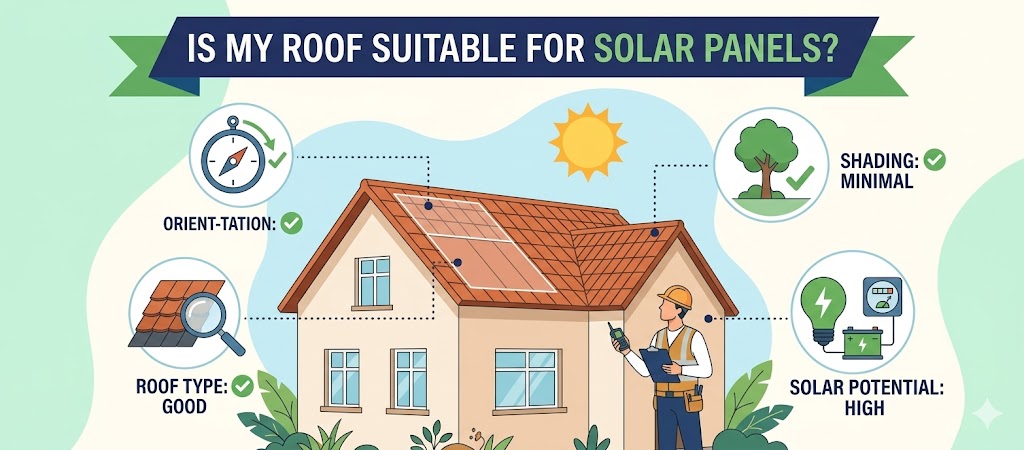
The vast majority of UK roofs can support solar panels. In most cases, the question of installing solar panels is more about how much energy a solar array can generate on a given roof size, pitch and orientation.
In this guide, we break down the key factors that determine whether your roof is suitable for solar:
With these in mind, you should be able to see if your house is right for solar panels. Contact The Solar Co for a free survey to fully assess your home’s suitability for a solar array on your South East England home.
The ideal orientation of a roof in South East England is south-facing, but nearly all directions will enable you to save money on electricity bills, by installing solar panels.
Broadly speaking, east- and west-facing roofs still perform well, generating around 80% of south-facing annual output.
North-facing roofs are least effective, achieving 50% or less energy generation than south-facing – but may still work in some configurations.
It is possible to arrange for a split array across different roof faces – and sometimes recommended if a north-facing aspect is dominant.
The UK’s latitude and angle to the Sun means that an ideal roof pitch angle is 30°–45°. Most roof pitches fall within this bracket, so in these cases you won’t need to adjust the angle of the solar panels to suit.
Where you have a flat roof, a special mounting frame can be installed to achieve the optimal tilt towards the Sun. At the other end of the spectrum, very steep pitches (over 60º) can reduce the output of a solar array but they rarely prevent the system from working.
Shading can be worse for a solar array’s generating potential than the direction it faces. With that in mind, when you are looking at having a system installed, it might be useful to see if shading is a problem. The classic case might be an old house in the middle of a street full of newer tall buildings that overshadow it year-round.
When you’re preparing to get a solar quote, it might help to look at your roof on a sunny day at different times of the day and year. In winter months you get bigger shadows, so you’ll get a better idea of any problems between September and March.
Common sources of shadows a roof include:
If shading is an issue, there are technologies like microinverters and power optimisers that can offset it. Talk to your MCS-approved solar installer to discuss what can be done.
The only two roof materials you cannot install solar panels on are thatched and asbestos roofs. In the case of thatch, there is a fire hazard and with asbestos there are health and safety problems for the installers.
The majority of UK roofs have concrete and clay tiles – these are the most straightforward materials on which to install a solar system. Other roof types include:
Most UK homes will require a 3-4 kilowatt peak (kWp) solar array, which can fit onto one face of a typical South East England home easily. Normally you only need roof space of 20-25m².
Standard solar panels measure roughly 1.6-1.7m² each and most systems use 8-12 of them in one block. Where this might hit problems is where there is a skylight, vent or chimney in the usable area – but it is possible to have an array split over multiple roof faces and spaces as required.
Not all roofs are the same, so discuss with your solar installer what the best design will be for your particular roof.
One of the most important things to consider ahead of having a solar installation is the condition of the roof.
As a rule of thumb, if you expect to need a major roof repair or replacement in the next 5-10 years, get this done before going solar. Solar panels will last 25-30 years, and it will take added expense to remove them for any repair should this be required.
Solar panels weigh 15-25kg per m², and most roofs in good condition will be able to hold it without any problems. After agreeing to take on an installer they will conduct a full site survey, both inside and outside the house and this will surface any problems. For older or unusual properties they will make additional calculations about roof strength and condition at this stage.
With the advice we have given above you should be able to make a fairly quick assessment about whether your South East England home is suitable for solar panels. At this stage, it’s time to get quotes from at least three MCS-certified installers.
The installation surveyor will model the expected output of the array, using specialist software, based on your specific roof geometry and location. This is based on shading, orientation, pitch, available space, and any planning restrictions. They will make an assessment of your roof condition too.
Most homeowners will soon find that even imperfect roofs are more suitable for a solar system than expected! Contact The Solar Co today to get a survey and we will discuss those imperfections with you.
Can I install solar panels on a north-facing roof? North-facing roofs are generally not recommended in the UK, as they receive significantly less direct sunlight and typically generate less than 50% of the output of a south-facing system. In most cases, this makes them uneconomical. However, an installer can assess your roof and confirm whether any output would still be worthwhile based on your specific setup.
What if my roof is partially shaded by trees or a chimney? Partial shading doesn’t rule out solar, but it can reduce overall system performance. A professional installer will carry out a shading analysis during the survey and may recommend solutions such as optimisers or microinverters to minimise the impact. In many cases, systems can still perform well with careful design.
Do I need planning permission to add solar panels to my roof? In most cases, no. Solar panels are typically classed as permitted development in the UK, meaning planning permission isn’t required. Exceptions apply for listed buildings, conservation areas, or certain leasehold properties, so it’s always worth checking with your installer or local authority if you’re unsure.
Can solar panels be installed on an older roof? Yes, but the condition of the roof is important. Solar panels are designed to last 25–30 years, so your roof should be in good structural condition before installation. If repairs or replacements are needed, it’s usually more cost-effective to carry these out beforehand.
How do I know if my roof is structurally strong enough? Your installer will assess this during the site survey. They’ll check the condition of the rafters, roof covering, and overall structure to ensure it can safely support the system. If there are any concerns, they may recommend a structural assessment or minor reinforcement before installation.
Most roofs are suitable for a solar array, with relatively few being the wrong material or in too poor condition to have one installed. The most important factors to consider when assessing whether your roof is suitable for a solar system are:
The best thing to do is to ask for an MCS-certified installer to survey the roof to get a professional opinion. Call The Solar Co today to get a free home assessment to see how much money you can save on electricity with a new solar system.
Back to Blog