
Energy Savings Calculator
0203 193 8888


0203 193 8888
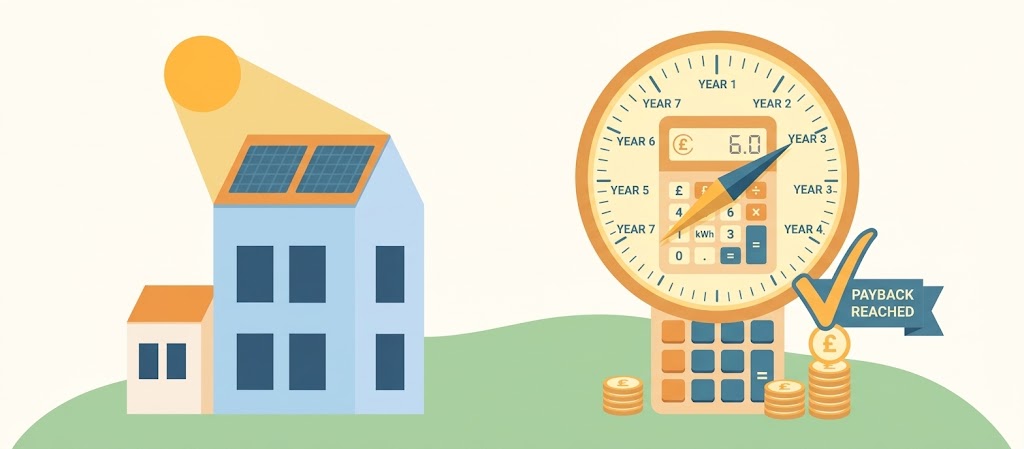
For many well-specified UK systems, payback may fall somewhere between 8 and 15 years, although particularly favourable installations can recover their cost sooner. With panels commonly operating for 25 years or more, a suitable system can continue reducing electricity costs for many years after reaching break-even. Below, we walk through the exact formula, the factors that move it, and a worked example you can compare against your own quote.
In simple terms, your solar panel payback period is the length of time it takes for the money you save on electricity bills, plus any income from exporting surplus power through the Smart Export Guarantee, to equal what you paid to have the system installed. Once the initial investment has been recovered, subsequent generation continues to reduce electricity bills and may earn export income, subject to any maintenance or equipment-replacement costs.
There are two broad ways to model payback. Simple payback divides the net installation cost by the expected first-year financial benefit. A more detailed year-by-year model can allow for changing electricity and export prices, gradual panel degradation, maintenance costs and possible inverter replacement. It can also discount future savings to reflect the fact that money received several years from now is worth less than money saved today. Payback period matters more than the headline savings percentage often quoted by installers, because two systems with similar advertised savings can have very different upfront costs, and therefore very different break-even points.
This is a simplified first-year calculation. A fuller assessment subtracts expected annual costs and allows for changes in system output and tariffs over time.
The solar panel payback period calculation formula is more straightforward than it looks:
Payback Period (years) = (Total Installation Cost − Grants) ÷ (Annual Bill Savings + Annual SEG Income)
Each variable is easy to find if you know where to look:
Add your bill savings and SEG income together, divide the net installation cost by that total, and you have a simple payback estimate in years. This is the version most homeowners use to sense-check a quote. A more advanced discounted calculation exists for readers who want a more precise, inflation-adjusted figure, which we cover later in this guide.
Several variables influence how long it takes your system to pay for itself, and small differences in any one of them can shift your payback period by a year or more.
It helps to see the formula in action. Take a typical 4kW solar system installed for £6,500, with no grants applied in this example, and combined bill savings plus SEG income of around £600 per year.
Payback Period = £6,500 ÷ £600 = approximately 10.8 years
In this example, the initial installation cost would be recovered after roughly 10 to 11 years. The panels could then continue generating savings and export income for many more years, although the homeowner should allow for possible maintenance and equipment replacement. In particular, an inverter may need replacing during the operating life of the panels.
It’s worth stressing that this is one illustrative example, not a universal outcome. A homeowner with higher electricity usage, a more competitive SEG tariff, or a south-facing roof might see payback closer to 7 or 8 years, while a smaller system, higher installation cost, or less favourable roof could push payback towards the upper end of the 7 to 12 year range. The only way to know your own figure with confidence is to run the formula using the actual numbers from your quote and your household’s usage pattern, rather than relying on a generic industry average.
Adding battery storage to a solar installation changes the payback calculation in two directions at once. On one hand, a battery lets you store surplus daytime generation and use it in the evening instead of exporting it at the typically lower SEG rate or drawing expensive grid electricity after dark. This increases your self-consumption rate and can significantly boost annual bill savings.
On the other hand, batteries add a significant amount to your upfront installation cost, which increases the top of the payback formula at the same time.
In practice, combined solar-plus-battery payback periods tend to come out similar to, or slightly longer than, solar alone, depending on the size and cost of the battery you choose. The improved savings do not always fully offset the extra investment within the payback window. However, a battery can still make sense for energy security, resilience during power cuts, or maximising self-consumption. The only reliable way to see the real impact on your specific numbers is to request a combined solar-and-battery quote and run both scenarios through the formula side by side. Ask for separate solar-only and solar-plus-battery projections showing the additional battery cost and the additional annual saving it is expected to create.
Qualifying professionally installed solar panels and battery storage currently benefit from zero-rate VAT, with the temporary relief scheduled to run until 31 March 2027. The quotation should already reflect the applicable VAT treatment, so do not subtract a further VAT saving from the quoted total when calculating payback.
The second is any grant or funding scheme you may be eligible for. Availability changes over time and can depend on your local authority, income, or property type, so it’s worth checking current eligibility for regional or national schemes before you commission an installation rather than assuming a flat national rate applies to everyone.
Start with the amount the homeowner will actually pay after any non-repayable grant. If the system is financed, include interest and fees when comparing the total cost with projected savings. The VAT rate shown on the quotation should already be included in that final amount.
Simple payback uses the installation cost and expected annual benefit to produce an easily understood break-even estimate. It is useful for comparing quotations, but it assumes that annual generation, electricity prices, export payments and operating costs remain broadly constant.
A detailed forecast calculates the cash benefit year by year. It can include panel degradation, changing tariffs, maintenance, inverter replacement and electricity-price assumptions. A properly discounted calculation also reduces the present value of future savings, which will normally produce a longer payback period than the simple calculation unless other assumptions—such as rising electricity prices—offset that effect.
For an initial comparison, simple payback is perfectly adequate. Before committing, however, ask the installer to explain the assumptions behind its projected generation and financial return. A highly precise answer based on speculative future energy prices is not necessarily more reliable than a transparent range.
While some factors, like your roof’s orientation, are fixed, there is plenty you can do to bring your payback period down:
Small adjustments across several of these areas can shave a year or more off your payback period without changing the system itself.
What is a good payback period for solar panels in the UK?
A payback period of roughly 8 to 15 years can represent a reasonable result for a domestic UK system, depending on installation cost, generation, consumption and export income. Shorter returns are possible in favourable circumstances. A longer period is not automatically a bad investment, but it is worth checking the generation estimate, self-consumption assumption, export rate and allowance for future equipment costs.
Does adding a battery increase or decrease my payback period?
It can go either way, though it more often lengthens payback slightly rather than shortening it. A battery increases your self-consumption by letting you use stored daytime generation in the evening, which boosts annual savings. Still, it also adds a substantial amount to your upfront cost. Whether the improved savings outweigh the extra investment within the payback window depends on the battery’s size, price, and your household’s usage pattern. Requesting a combined solar-and-battery quote lets you compare the numbers directly rather than guessing.
How does the Smart Export Guarantee affect payback time?
SEG payments and solar payback are closely linked, because the SEG is the income side of the payback formula alongside your bill savings. Every kWh of surplus electricity you export earns a per-unit payment from your supplier, and since SEG rates vary from roughly 3p to 27p per kWh depending on the tariff, choosing a competitive SEG rate rather than the first one offered can noticeably shorten your payback period. It is worth reviewing your SEG tariff periodically, in the same way you would shop around for any other utility contract.
Do solar panels still save money after the payback period ends?
Yes. Once cumulative savings and export income have recovered the initial investment, subsequent generation continues to provide a financial benefit. It is not necessarily pure return, because an inverter may need replacing and occasional maintenance can arise, but panels commonly operate for 25 years or more. A system reaching break-even after ten years can therefore have many years of useful generation remaining.
How accurate are online solar payback calculators?
Online calculators can give a useful ballpark figure. Still, their accuracy depends entirely on the quality of the assumptions behind them, particularly the electricity price, SEG rate, and generation estimate they use. A calculator using generic national averages will be less accurate for your specific home than working through the formula yourself using the actual figures from your quote and your own recent energy bills. Treat online tools as a starting point for a rough estimate, and verify the result against your own numbers, or ask your installer to walk through the calculation with you, before treating any figure as final.
Solar payback depends on installation cost, expected generation, household consumption and the export tariff. For many UK homes, a period of approximately 8 to 15 years may be realistic, with stronger projects recovering their cost sooner. The most reliable estimate is based on the property’s roof and location, recent electricity consumption and clearly stated tariff assumptions.
If you’d like a personalised, no-obligation payback estimate based on your own roof, usage, and location, get in touch with The Solar Co today, and we’ll walk you through the real numbers for your home.
Back to Blog