
Energy Savings Calculator
0203 193 8888


0203 193 8888
With energy prices remaining volatile, more UK homeowners are turning to solar panels to reduce their reliance on the grid. This guide will show you how they work – don’t worry, though, you won’t need any technical knowledge to understand it! The guide covers:
On peak days, solar has supplied over 30% of the UK’s electricity demand – it is no gimmick and can genuinely save you a lot of money on energy bills. Contact The Solar Co to discuss installing solar panels on your home’s roof today.
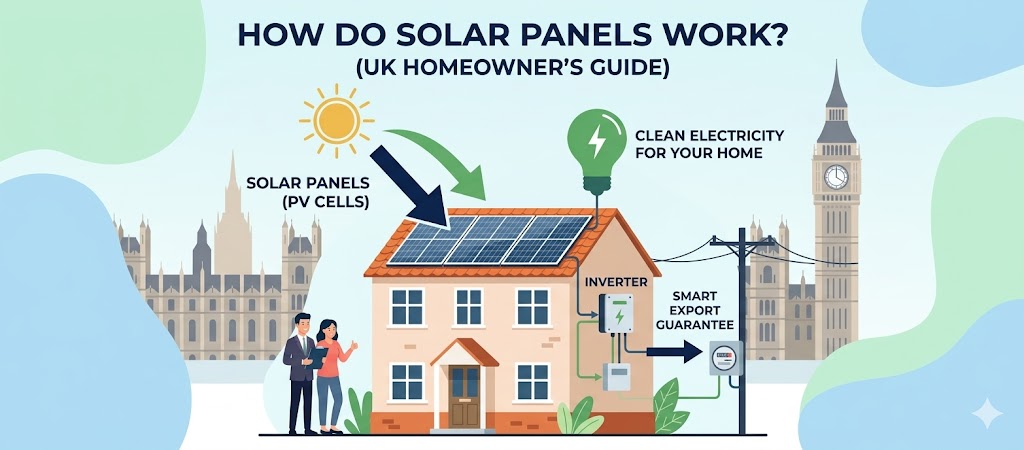
‘Photovoltaic’ means ‘photo’ (light) + ‘voltaic’ (electricity). Solar panels contain silicon, which is a semiconductor that releases electrons – charged particles – when hit by particles of light (photons). When the electrons are released, they form an electrical current.
We refer to ‘light’ and not ‘heat’. Though you can get solar water heaters that use the heat of the Sun to warm water, photovoltaic panels only require light to release electricity. Where a solar water heater will work better on a warm day, solar panels only need light to release electricity. As such, they work on both cloudy days and sunny days.
Solar panels are 20-23% efficient, meaning that roughly one-fifth of the sunlight that hits them produces usable electricity.
Broadly there are four components of a solar panel: Tempered glass at the top that acts as a transparent armour. On the glass is an anti-reflective coating that ensures most of the light reaches the silicon layer beneath.
Beneath the glass are the silicon cells that can be monocrystalline or polycrystalline.
These cells are more efficient than polycrystalline but are more expensive. These are the dominant technology used on modern solar panels today. As well as being more efficient, they are more durable. The chief drawback is that they are slightly more expensive than polycrystalline.
Polycrystalline cells were more common a while ago, but aren’t very widely used today. They are generally less efficient and cheaper than monocrystalline cells, which is why they are now less commonly used.
Beneath the cells is a durable black sheet.
Cells are wired together into modules (panels), and multiple panels form the array on your roof. A typical panel is the size of a large door – 1.1m x 1.7m. These sit on an aluminium frame that connects to the roof-rails and then to the roof itself.
The array (and sometimes individual panels themselves) is connected to an inverter that we will look at in the next section.
Panels emit electricity as a ‘direct current’ – DC. Your home mains electricity system is ‘alternating current’ (AC) – a system invented to transmit high-voltage electricity long distances from the power station to where it’s needed. The inverter converts the DC to AC.
In addition to supplying the same type of power as the rest of the home, the inverter is the ‘brains’ of the solar array. It both manages the output of the solar array and, in most modern systems, sends you information via an app on how everything is working in real time.
There are two types of inverters – the ‘string inverter’ and ‘microinverter’.
Most home arrays have string inverters that connect to all of the panels, and you only have one of them. They can be less efficient because the weakest-performing panel limits system’s overall performance. If there is a shadow from the chimney over one panel, for example, the system output is reduced to match the performance of the shaded panel.
They usually last 10-12 years, so you will likely have to replace it within the life of the solar array. String inverters, however, are cheaper than microinverters, which is why these are installed on most UK homes’ roofs.
With microinverters, there is one per panel – they are more efficient, cost more, but can last considerably longer than the string inverter. Where the string inverter only releases the lowest voltage from all the panels, the microinverter will release all of the energy from each panel, allowing for better use of the light hitting each cell.
Being more efficient but more expensive, we tend to install microinverters where there is shading on the roof or where it is pointed in an unfavourable direction (e.g. a NE-facing roof). They do last longer than string inverters, so longer life offsets the added expense.
The inverter supplies electricity to your home consumer unit (‘fuse box’) and from there it powers the home. The home will always use your solar energy first, then top it up with grid electricity. This is known as ‘self-consumption’, and is the main way you will save on your electricity bills.
Once your solar array is installed, you will find it cheaper to power your large electrical appliances during the day from solar power. A 4 kWp array might generate 3kW of power on a sunny April afternoon so the first 3,000 Watts being used by the house will come from the Sun. That will easily power a dishwasher and washing machine at the same time, as well as trickle-charge your EV’s battery.
The Smart Energy Guarantee allows you to sell excess energy to the grid, but the economics favour you using that energy rather than selling it, as we will see in the next section.
Particularly in summer, your solar panels will often generate more electricity than you use. In these instances, the excess energy will be released to the grid, powering other homes on your street. The Smart Export Guarantee (SEG) comes with an MCS-certified solar installer fitting the panels, and ensures that you get an income from that excess energy being sent to the grid.
SEG payments typically range from around 4–15p/kWh depending on the supplier. As with electricity and gas suppliers, it pays to shop around to maximise your income. With the Energy Price Cap set at around 25p/kWh, if you went ahead and used your washing machine after daylight hours you’d be paying 10p/kWh more than you would makeback when the Sun is shining. As such, it makes economic sense to use your energy rather than keep your old habits before the array was installed.
Another worthwhile investment is a home battery. If you’re selling the excess energy at a 10p/kWh loss, you could save the 10p by storing it in the battery and using it at night. A 5kWh battery can often cover most of your evening electricity use. That could mean your electricity bill for the day is £0, while you’d still pay for the electricity in the evening without one.
Yes, they do. The way they work is photons knocking electrons off silicon. It even happens on cloudy days as light still hits the solar cells. There is still some reduction, however, which is why on a slate-grey January day you will get less power than on a bright June day. Under heavy clouds, panels will generate as little as 10-25% of peak capacity, but under light clouds, 40-80%.
One issue you will face is seasonality: there are far fewer daylight hours in mid-winter than mid-summer. You will find that 65-75% of your annual generation comes between April and September, with far less in the winter months. The SEG again makes this worthwhile, with excess energy sold in summer helping partially cover your winter electricity consumption.
Particularly in the South East of England, the UK receives enough solar irradiation (750-1,100kWh/m²) to make solar panels a sound financial investment.
A typical 4kWp system comprises 10, 400W panels. On a south-facing roof in South East England, a solar array will generate around 3,400-4,200kWh over a year. Most homes consume around 2,700kWh per year.
If you fall into the habit of using all your big appliances during the day, the savings soon mount up:
It soon translates into big cost savings throughout the year.
Several factors can reduce overall output: While a south-facing array at a 30-35º tilt is optimal, east or west-facing roofs generate 15-20% less energy over a year, and a north-facing array less than 50%. Trees, chimneys and neighbouring buildings can also affect generation – though in all of these instances, you can consider a more efficient system with microinverters and monocrystalline cells. Taking these factors into account makes sense to get a solar survey before making the final decision to invest.
Yes — solar panels generate electricity from daylight, not direct sunlight. Output is lower on heavily overcast days, but they will still produce power. In the UK, a typical system continues generating year-round, just at reduced levels in poor weather.
In most cases, your system will automatically shut down during a power cut. This is a safety feature to prevent electricity from being sent back into the grid while engineers are working on it. If you want backup power, you’ll need a battery system with islanding capability.
Most residential solar systems in the UK pay for themselves within 6–10 years. This depends on factors like system size, electricity usage, and whether you include a battery. With panels lasting 25–30 years, that leaves many years of savings after payback.
No — south-facing roofs deliver the highest output, but they’re not essential. East- and west-facing roofs can still generate around 65–80% of optimal output, and are often cost-effective. A professional survey will confirm what’s viable for your specific roof.
Yes — batteries can be installed alongside solar panels or added later. They store excess electricity generated during the day so you can use it in the evening, increasing your self-consumption and reducing reliance on the grid.
Now that you have a basic understanding of how solar panels work, you can see why solar can make financial sense to install them here in the South East of England.
The UK climate is well-suited to solar, particularly in the South East. Get in touch with The Solar Co today to book a free, no-obligation survey with us to see just how much a bespoke system for your home can save you on energy bills.
Back to Blog