
Energy Savings Calculator
0203 193 8888


0203 193 8888
Estimated reading time: 8 minutes
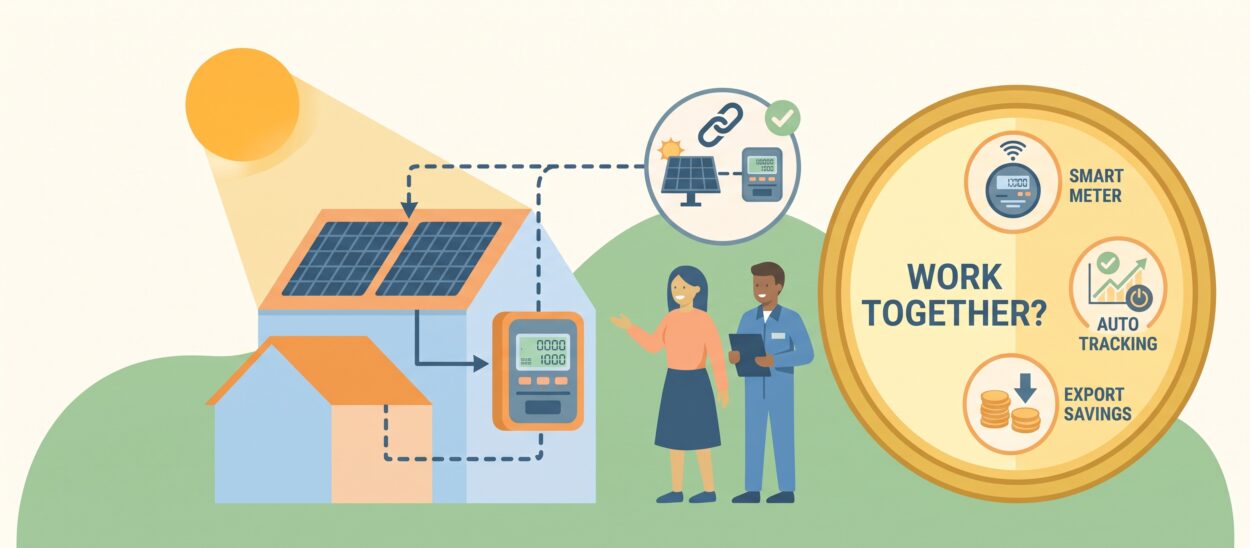
Smart meters and solar panels can work together, but installing a smart meter does not automatically set up export payments. This guide explains what the meter measures, how SMETS1 and SMETS2 differ, what the Smart Export Guarantee requires, and how to resolve reporting problems. It focuses on South East homeowners within the Great Britain smart-meter and SEG arrangements.
An electricity smart meter records energy imported from the grid and, when suitably configured, exported to it. It can store half-hourly energy measurements and automatically communicate readings. It does not normally measure all solar generation or the home’s internal battery and appliance flows separately.
A traditional meter typically requires manual readings, whereas a smart-meter system can transmit them remotely via its communication equipment. The in-home display can show near-real-time information, but the frequency with which readings are stored or sent to a supplier is a separate matter. A display reading is not necessarily the same information used on an export statement.
Automatic readings can help suppliers bill for measured grid usage rather than estimates. For solar owners, the important checks are whether export is being recorded correctly and whether the export supplier can obtain the readings required by the chosen tariff. A working import account alone does not confirm export is set up.
Not all smart meters are equal, and this is where a lot of confusion starts. Early smart meters, known as SMETS1 (Smart Metering Equipment Technical Specifications, first generation), had a well-documented weakness: many lost their “smart” functionality when the homeowner switched energy suppliers, reverting to basic meters that had to be read manually again.
SMETS2 meters were designed to use the DCC national communications network and retain smart functionality when switching suppliers. Many SMETS1 meters have also been enrolled onto that network. Either the generation or the communication can experience problems, so SMETS2 does not guarantee that every reading will be transmitted successfully.
For SEG, the core metering requirement is an export meter capable of half-hourly measurements and an export Meter Point Administration Number (MPAN). A working SMETS2 meter or an enrolled SMETS1 meter is the usual domestic solution, but a suitable separate export meter can also meet the rules. Some suppliers require remote half-hourly data for a particular tariff; where remote reading is unavailable, discuss acceptable readings with the SEG supplier rather than assuming payments are impossible.
You do not need a smart meter simply to generate and use solar electricity. However, your existing import meter must be suitable for a property with generation. Some older meters can record incorrectly when electricity is exported. Tell your supplier about the installation and ask it to assess or replace an unsuitable meter; do not assume every traditional meter can remain unchanged.
For SEG, suitable half-hourly-capable export metering is required, rather than a universal requirement for a particular smart-meter generation. For domestic PV up to 50kW, the usual certification route is MCS or an accepted equivalent scheme. Some suppliers offer separate discretionary non-MCS export applications. Check the chosen tariff’s documentation, metering and communications conditions before applying.
Contact the import supplier and proposed export supplier early. Confirm meter suitability, export-register configuration, certification and the export MPAN process. A meter replacement, if necessary, is only one part of export setup; the supplier must also complete its checks and agree the tariff start date.
A meter can stop sending automatic readings due to communication coverage issues, a communications hub problem, configuration or supplier data issues, or a meter fault. Some older SMETS1 meters historically lost remote functionality after supplier changes, but many have since been migrated to the national network. A problem noticed after a solar installation does not, by itself, establish that the solar installation caused it.
A communications failure alone normally leaves the meter recording energy locally, but do not assume that every fault is only a communications issue. Check both import and export registers with the supplier. Keep dated readings and ask the export supplier whether manual readings or recovered data can be used to support payments under your tariff while the problem is investigated.
DCC and suppliers have migrated the vast majority of eligible SMETS1 meters to the national network. Contact the energy supplier to check the meter’s status and arrange the appropriate remedy; some issues can be resolved remotely, while others need an engineer or replacement. Import and export may be managed by different suppliers, so ask which party is handling any export data issues.
The supplier’s electricity meter measures flows across the boundary between the home and the grid: imports and exports. It does not normally show total PV generation, on-site consumption and battery charging as separate measurements. Those figures come from a generation meter, inverter, battery controller or additional monitoring equipment.
Electricity put into a home battery is not exported because it has not entered the grid. If the battery later supplies household appliances, it can reduce imports. If it later discharges to the grid, that outward flow is recorded as export, subject to the tariff’s rules on battery export and the source of the stored energy.
To assess storage, compare avoided import costs with forgone export income, conversion losses, and battery costs. A smart meter alone cannot identify whether exported electricity came directly from solar or from a battery. Suppliers may apply additional conditions, especially for batteries charged from the grid, so check the export contract.
How to Check or Upgrade Your Smart Meter for Solar
If you’re not sure what generation of meter you have, the process to find out and, if necessary, upgrade is straightforward:
• Check the meter’s make, model and serial number. An in-home display by itself does not reliably establish the meter generation or export capability.
• Ask the import supplier to confirm the meter type, communications status and suitability for solar; ask the export supplier whether it can obtain the required export data.
• If there is a problem, ask the supplier whether remote reconfiguration, communications work or replacement is appropriate. Domestic smart-meter installation normally has no upfront charge, but an enrolled SMETS1 does not automatically need replacing and appointment availability varies.
A solar installer can identify potential metering issues during a survey and explain the information needed for the export application. The supplier or its appointed meter operator normally arranges work on the supplier’s meter. Keep this separate from commissioning the solar inverter and its monitoring system.
Metering and export-application times vary. Ask for separate estimates for any meter work, export MPAN registration and tariff activation. Generating electricity or having a new meter fitted does not by itself establish a payment start date; obtain confirmation from the export supplier.
For a typical domestic SEG application, check certification under MCS or an accepted equivalent, eligible generation, appropriate export metering capable of half-hourly measurements, an export MPAN and an agreed export tariff. Confirm the supplier’s specific evidence and data requirements. SEG operates in Great Britain, rather than Northern Ireland, and a generation meter alone is not an export meter.
Export tariffs vary considerably between providers. Some offer a flat rate per kWh exported, while others use time-of-use pricing that pays more for electricity exported during peak demand periods. Because these rates and the providers offering them change fairly often, it’s worth comparing SEG tariffs at least annually rather than sticking with the first one you signed up for.
• Assuming a working import smart meter automatically means export readings, the export MPAN and tariff are active.
• Failing to check import and export readings after a supplier change or communications fault, or failing to ask whether manual readings can be accepted.
• Using inverter generation or battery-charge figures as though they were exported units, leading to inflated payment estimates.
• Waiting until after commissioning to discuss metering and export registration, or assuming payment automatically begins on installation day.
Yes, solar can operate without a smart meter, provided the import meter is suitable, and the installation meets its other requirements. SEG requires an export meter capable of half-hourly measurements and an export MPAN; a smart meter is the common domestic solution, but not the only possible one. Check the tariff’s conditions with the export supplier.
SEG requires half-hourly-capable export metering and an export MPAN. A functioning SMETS2 or enrolled SMETS1 is commonly used, while a suitable separate export meter may also qualify. The supplier may require remote data for its particular tariff, so confirm acceptance, certification and setup requirements before applying.
The timing does not establish the cause. Ask the supplier to check the communications, configuration, and the meter itself, and to confirm that export registration is complete. A communications fault normally leaves local readings available, but a recording fault needs investigation. Retain dated readings and ask how payments will be handled during the fault.
It records the effect on grid imports and exports rather than measuring battery charging and solar generation separately. Storing electricity is not export; using it at home can reduce imports, while later exporting it is recorded at the grid meter. Payment for battery export depends on the tariff and potentially on the source of the stored electricity.
There is no guaranteed generic turnaround. The supplier should explain appointment availability, whether the issue can be resolved remotely, and any additional work required. Meter installation and export-tariff activation are separate processes, so ask for the payment start date rather than assuming it matches solar commissioning.
Smart meters can support solar export payments and accurate grid billing, but they do not measure every internal energy flow within a household. Check meter suitability, export configuration, certification, the export MPAN and the tariff’s requirements. If automatic reporting stops, contact the supplier promptly and retain readings while the issue is resolved.
If you are planning solar or battery storage, ask The Solar Co about the installation documents and metering checks needed for your export application. Your energy suppliers can confirm meter suitability, arrange any supplier-meter work and explain the export tariff’s start date and reading requirements.
Back to Blog