
Energy Savings Calculator
0203 193 8888


0203 193 8888
Estimated reading time: 8 minutes
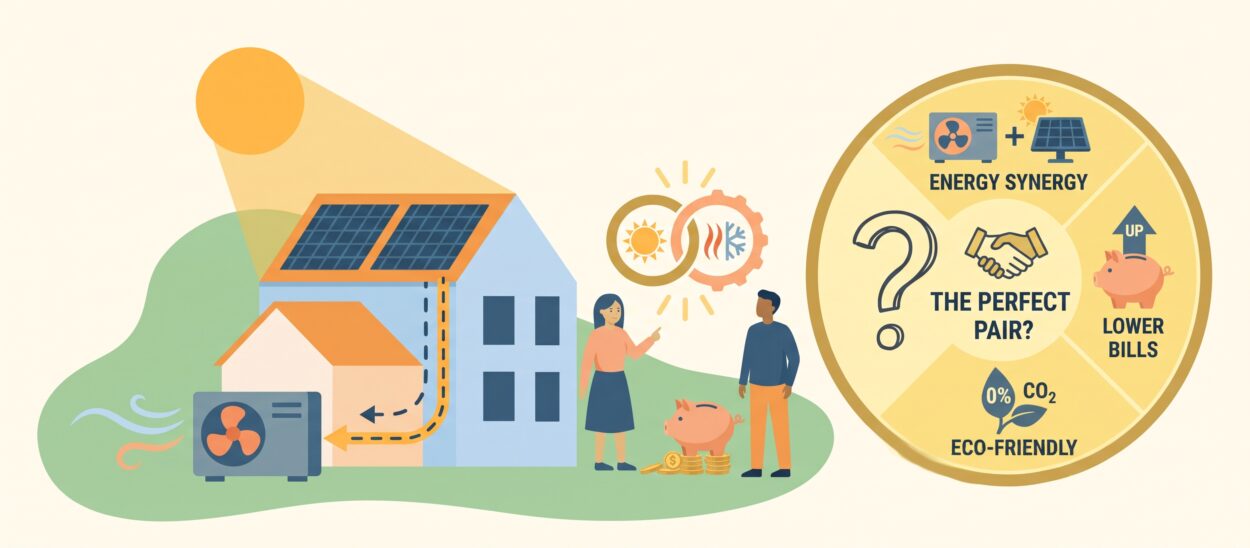
Solar PV and heat pumps can complement each other, but their seasonal patterns don’t align: solar generation peaks in summer, while space-heating demand peaks in winter. This guide explains how they interact, why savings vary by property and tariff, and what to consider when sizing PV, storage and heating equipment.
Heat pumps use electricity to deliver heat, and demand typically increases in colder weather. Solar PV generates during daylight and generally produces more in summer than winter. The key issue is how much solar output coincides with heat-pump demand.
A conventional electric heat pump can use electricity generated by an ordinary solar PV system; no dedicated ‘solar heat pump’ is required for that pairing. Solar-assisted heat pumps are a separate technology, so it’s inaccurate to say no such category exists. The home draws from available generation and the grid according to its electrical setup, not because the heat pump chooses the cheapest source.
Daytime hot-water heating may increase direct use of solar generation. Whether this is financially worthwhile depends on heat-pump efficiency at that time, import and export tariffs, and the controls. A battery stores electricity for later use; an immersion diverter generally directs surplus electricity to a resistive hot-water element.
There is no defensible universal annual saving of £1,030–£1,732 from combining solar PV with a heat pump. Savings depend on the original heating fuel, heat demand, PV yield, self-consumption, tariffs, equipment cost and any battery. Energy Saving Trust modelling finds that combinations can substantially reduce bills in some cases, but no single savings range applies to typical homes.
For a meaningful example, compare two clearly defined homes or scenarios using annual heat demand (kWh), heat-pump seasonal performance, PV generation (kWh), hourly import/export, electricity and gas tariffs, standing charges and installed costs. Without those inputs, a claim that a typical three-bedroom home saves £1,200 annually is not substantiated.
A battery can increase the share of solar generation used in the home, but there is no reliable universal jump from 45% to 75% for a 10kWh battery. The result depends on battery size, round-trip losses, household load, export tariffs, and season; higher self-consumption doesn’t always mean a higher financial return.
The value of the combination depends on how and when the household uses electricity, how much heat it needs, its electricity and export tariffs, and the upfront cost of any battery. Any savings comparison should include solar export payments rather than treating them as negligible.
Solar PV can offset some annual electricity use, but a fixed claim that it covers 50% of a heat pump’s consumption, or 30–40% in winter, is not generally supportable. A home’s actual match depends on generation, heating demand and timing. Even if annual solar generation equals heat-pump consumption, the grid is still needed when output is low.
Short-duration home batteries can shift electricity from daytime to evening or overnight; they cannot store summer solar output for use the following winter. Winter demand is normally met by a combination of contemporaneous PV generation and imported electricity, potentially on a time-of-use tariff.
None of this makes the combination unviable. It simply means you should plan for the seasonal mismatch from the outset, rather than assuming it away when sizing a system.
A solar diverter is a relatively simple device that redirects surplus midday solar electricity into an existing hot water cylinder instead of letting it flow to the grid for export. For homes with a hot water cylinder already in place, it’s often the cheapest way to use spare solar generation.
Costs for diverters and batteries vary widely with equipment, installation and usable capacity. The draft’s £400–£700 diverter price, £6,000 battery price and 2–4 versus 8–15 year payback ranges are not sufficiently evidenced to present as general UK averages. Obtain like-for-like installed quotations and calculate the value of avoided imports less foregone export income.
A conventional solar immersion diverter powers a resistive element in the hot-water cylinder, not the heat pump’s compressor. Because an immersion element typically delivers about one unit of heat per unit of electricity, diverting surplus solar to it can be less economical than running a heat pump with a COP above one—especially when export payments are available.
SCOP (seasonal coefficient of performance) describes expected seasonal heat output divided by electricity input under specified test conditions. The real-world seasonal performance factor (SPF) is measured during operation. A 2026 study found a mean SPF of 3.86 in the self-selected HeatpumpMonitor.org dataset, but that is not a representative UK-wide average; another monitored dataset in the same study performed differently.
Ask installers for the design SCOP and expected running conditions, including flow temperatures. Actual efficiency depends on heat-loss design, controls, hot-water demand, weather and occupants’ use. Do not treat a high published SCOP as a guaranteed household result.
Use an appropriately qualified installer and obtain a room-by-room heat-loss assessment and emitter design. For installations seeking the Boiler Upgrade Scheme, the installer must meet the scheme’s MCS certification requirements. Heat-pump size should follow the home’s design heat loss rather than a rule of thumb.
Weather compensation adjusts heating flow temperature based on outdoor conditions, while scheduling or energy-management controls can shift some loads toward solar-rich hours. Not all systems automatically optimise for solar, and excessive changes to space-heating schedules can reduce comfort or efficiency.
Combined costs for a heat pump installation alongside a solar PV system vary considerably depending on property size, heat pump specification and array size; for a detailed breakdown, our dedicated cost guides cover each system individually. Taken together, though, several grants and incentives are worth factoring in from the outset.
The Boiler Upgrade Scheme currently offers £7,500 for eligible air-to-water and ground-source heat pumps, and £2,500 for eligible air-to-air heat pumps. The installer applies for the grant and deducts it from the customer’s quote, subject to scheme conditions.
Until 31 March 2027, an eligible off-gas-grid property heated by oil or LPG, with no mains gas connection, may receive £9,000 in total towards an air-to-water or ground-source heat pump (£7,500 standard grant plus a £1,500 uplift). This is not a general £9,000 grant for all off-grid homes.
The requirement to complete loft or cavity-wall insulation recommendations on an EPC before receiving a BUS grant was removed from 8 May 2024, not April 2026. A valid EPC may still be required, and insulation can still improve heat-pump performance.
Qualifying installed solar panels currently benefit from 0% VAT until 31 March 2027. This relief applies to qualifying installations, not simply to any retail purchase of solar equipment.
Installing PV and a heat pump together may simplify project planning and coordinate system sizing, but scaffolding and labour aren’t necessarily shared: the trades and work locations often differ. Ask installers for an itemised quote before claiming a combined-project saving.
That said, there’s a reasonable case for phasing the two projects for homeowners managing budget in stages. This spreads the cost over a longer period and lets you assess and pay for each system independently.
Which upgrade to prioritise depends on the existing boiler, household electricity demand, available grants, tariff options and budget. Neither a heat pump nor PV is automatically the cheaper first step for all gas, oil or LPG homes.
A handful of habits and small investments make a noticeable difference to how well solar and a heat pump work together in practice:
● Consider scheduling hot-water production for sunny periods when the tariff and heat-pump controls make that advantageous. Avoid routinely boosting space-heating flow temperatures solely to absorb solar output without assessing efficiency and comfort.
● Use a smart energy app or an in-home display to track solar output in real time and shift usage accordingly, rather than relying on habit alone
● Compare an immersion diverter, direct heat-pump hot-water scheduling and battery storage using the value of exported electricity and the heat pump’s COP. A diverter is not automatically the best low-cost first investment.
● Get a professional assessment of the home’s insulation and heat loss before sizing either system, since this affects both heat pump demand and how quickly solar pays for itself
A conventional air-to-water or ground-source heat pump can run alongside an ordinary PV system without a special ‘solar heat pump’ model. Solar-assisted heat pumps also exist as a separate category. Effective integration depends on wiring, controls, heat demand and tariff arrangements.
Not necessarily. Compare the array’s expected annual output with your heat pump’s forecast electricity use, and check when each occurs. Annual generation may match demand, but winter and overnight consumption may still require grid imports.
For eligible installations, the Boiler Upgrade Scheme offers £7,500 for air-to-water or ground-source heat pumps, or £2,500 for eligible air-to-air systems. Qualifying oil/LPG-heated properties without mains gas may receive £9,000 for eligible air-to-water or ground-source systems until 31 March 2027. Qualifying installed solar PV currently benefits from 0% VAT, rather than a universal solar cash grant.
A conventional immersion diverter can direct surplus solar electricity to a hot-water cylinder’s immersion heater; it does not directly drive a heat pump compressor. Whether that saves money depends on the heat pump’s COP, the import tariff, and the foregone export payment.
Size the solar array based on your available roof space, expected annual generation, household load, expected heat-pump electricity demand, and hourly usage pattern. A 4–5kWp system is not a universal requirement; a tailored generation and demand assessment is more reliable.
Heat pumps and solar PV can reduce fossil-fuel use and electricity purchases, but their financial benefits vary considerably. Evaluate the winter generation gap, export tariffs, system controls, and equipment costs together rather than relying on headline savings figures.
If you’re weighing up solar, a heat pump or battery storage, ask The Solar Co which services it provides and request an itemised assessment of the proposed system. Any claim that it designs or installs all three technologies should be confirmed by the company before publication.
Back to Blog