
Energy Savings Calculator
0203 193 8888


0203 193 8888
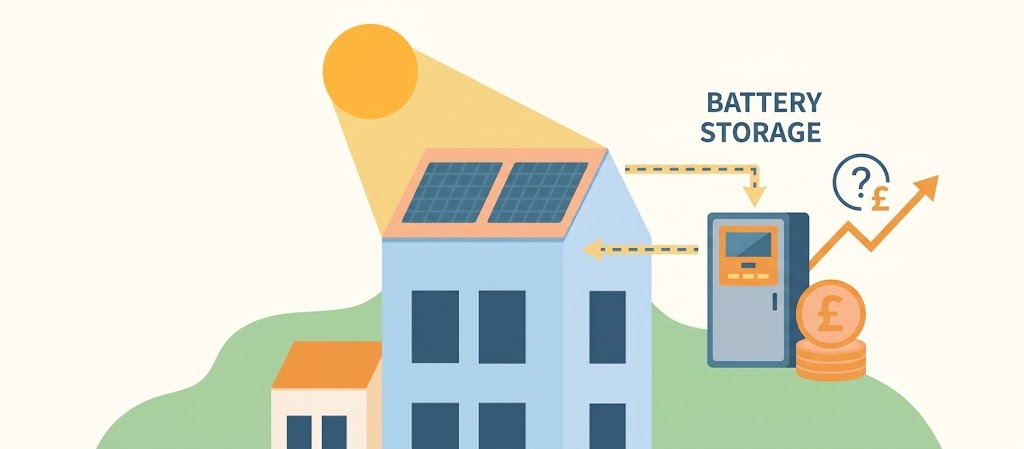
If you already have solar panels, or you’re considering them, there’s a good chance you’ve asked yourself one question: is a solar battery actually worth the extra cost? It’s one of the most common questions we hear from homeowners across the South East, and the honest answer is that it depends on your circumstances. This guide walks through the real costs, realistic savings, and typical payback periods for solar battery storage in the UK, along with the scenarios where a battery makes the most sense and those where it might not. By the end, you should have a clear, balanced view of whether battery storage is the right next step for your home.
A solar battery simply stores the surplus electricity your solar panels generate during the day, so you can use it later in the evening or overnight, rather than losing it to the grid at a low export rate.
The cycle is straightforward. Your solar panels generate power throughout daylight hours, and any electricity you don’t use immediately is diverted into the battery instead of being exported. Once the sun goes down and your panels stop generating, the stored energy is drawn down to power your home, reducing how much you need to buy from your supplier.
Battery costs vary by capacity, brand, and installation complexity, but there are clear price bands homeowners can use as a starting point. A 5 kWh battery typically costs between £3,000 and £4,500 installed, a 10 kWh system runs from £5,500 to £7,500, and larger 13 kWh or above systems tend to reach £7,000 to £9,500. For context, the MCS average for a battery installation in 2024 was around £8,035.
Installing a battery at the same time as your solar panels is usually cheaper than retrofitting one later, since the installer only needs to visit once and some equipment can be shared. It’s also worth knowing that 0% VAT currently applies to battery installations in the UK until March 2027, which meaningfully reduces the overall cost.
Price also depends on battery chemistry and brand. Lithium iron phosphate (LFP) batteries are now the most common choice thanks to their safety and longevity, but the specific brand and the complexity of your installation will still affect the final quote.
A battery’s main financial benefit is increasing your solar self-consumption, typically from around 30 to 40 percent without storage up to 70 to 85 percent with a well-sized battery. In practical terms, that means far more of the electricity your panels generate is used inside your home rather than exported at low rates.
Realistic annual savings for households with solar and a battery typically fall between £600 and £1,000 or more, depending on usage and tariff. This is largely because electricity you store and use yourself is worth roughly 5 to 7 times more than electricity exported to the grid under the Smart Export Guarantee.
Even homes without solar panels can benefit. A standalone battery charged overnight on a time-of-use tariff can save around £130 to £200 per year simply by shifting consumption away from peak-rate electricity. That said, savings depend heavily on your household’s energy usage, your tariff, and how well the battery is sized to match your actual demand, so figures should be treated as a guide rather than a guarantee.
For most UK households, the typical payback period for a battery installed alongside solar panels is 6 to 10 years, with an average of around 7 years. This varies by household size and battery capacity: smaller households with a 5 kWh battery may take around 8 years to break even, medium-sized households with a 10 kWh system are typically closer to 7 years, and larger households with 15 kWh or more can see payback in around 6 years.
Payback is significantly faster for homeowners on smart tariffs such as Octopus Go or Octopus Flux, which allow charging from the grid at around 7 to 8p per kWh and discharging at peak rates of 24p or more. The gap between cheap and peak rates is where a lot of the real value is unlocked.
Rising electricity prices and steadily improving battery efficiency mean that return-on-investment projections are getting stronger year on year, not weaker. Over a 10-year lifespan, a well-used battery system can realistically contribute £7,000 to £10,000 in total savings, comfortably outweighing the upfront cost for most households.
Battery storage delivers the strongest value in a few clear scenarios.
A battery is less cost-effective for households with very low energy usage, or for those who are home all day and already use most of their solar generation live as it’s produced.
It’s also worth weighing the non-financial benefits. Batteries can provide backup power during grid outages when paired with a compatible inverter and gateway, and households aiming for greater energy independence or a lower carbon footprint will find a battery worthwhile regardless of pure financial payback. Pairing a battery with an electric vehicle charger or a heat pump can amplify savings further, since the system can manage exactly when energy is drawn from storage versus the grid.
MCS-accredited installers across the UK typically work with a handful of well-established brands, including Tesla Powerwall, GivEnergy, Growatt, SolarEdge, sonnen, and Sungrow. Each has its own strengths: Tesla Powerwall is known for its premium software and backup capability, GivEnergy is popular for its value and strong UK-based customer support, and sonnen is favoured for its premium build quality and participation in grid services schemes.
Battery chemistry matters too. Lithium iron phosphate (LFP) batteries offer better cycle life and improved thermal safety compared with older lithium-ion NMC batteries, which is why LFP has become the standard choice for most UK installations.
Most modern battery systems are also modular, meaning capacity can be expanded in future if your household’s energy needs grow. Whichever brand you’re considering, it’s worth choosing one recommended and installed by an MCS-accredited installer, since this protects your warranty and ensures the system meets UK grid compliance requirements.
If you already have solar panels without a battery, retrofitting one is entirely possible in most cases. Compatibility depends largely on your existing inverter: some inverters already support AC-coupled batteries with no modification needed, while others may require a new hybrid inverter to work with a battery.
Retrofit installations typically cost slightly more than buying solar and battery storage together, largely due to the additional wiring and equipment checks involved. The good news is that the 0% VAT benefit applies to retrofit battery installations too, not just new combined installs, so you won’t lose out on that saving by waiting.
The best first step is to have a qualified installer assess your existing system. They’ll be able to confirm compatibility and recommend the battery option that fits your setup and household needs.
For most homeowners with solar panels and moderate to high electricity usage, the pros clearly outweigh the cons. For households with low usage or already very favourable export rates, the case is less clear-cut, and a full quote and energy audit from an installer is the best way to assess your personal circumstances.
Pros:
Cons:
Is solar battery storage worth it without solar panels?
Standalone batteries can still save you money by charging on a cheap overnight tariff and discharging during peak hours, but the savings are more modest, typically around £130 to £200 per year, and payback periods are much longer than for battery systems paired with solar panels. The best value by far comes from combining a battery with solar generation, where stored energy replaces expensive grid electricity rather than simply shifting when you buy it.
Can I get a grant for solar battery storage in the UK?
As of 2025, there are no direct government grants for standalone battery storage. However, the 0% VAT benefit saves homeowners several hundred pounds on installation costs, and some local authority schemes may offer additional support depending on where you live. The ECO4 scheme can also apply to eligible low-income households, so it’s worth checking your eligibility before ruling out financial support altogether.
How long does a solar battery last?
Most modern lithium iron phosphate batteries are rated for 6,000 to 10,000 charge cycles and typically come with 10-year performance warranties guaranteeing 70 to 80 percent capacity retention over that period. In practice, this means a battery installed today should still be performing well into the mid-2030s, with only gradual capacity loss rather than a sudden drop-off.
Does a solar battery work during a power cut?
Not automatically. Backup capability during a power cut requires a compatible gateway or energy management system that’s specifically configured for off-grid mode. Not all battery installations include this by default, so if backup power is important to you, confirm the exact specification with your installer before purchase rather than assuming it’s included as standard.
What size solar battery do I need?
A typical UK home with 3 to 4 bedrooms and around 4,000 kWh of annual electricity usage is usually well suited to a 10 kWh battery, while smaller households may find a 5 kWh system sufficient. The right size ultimately depends on your solar generation and daily usage patterns, so a qualified installer should size the battery to match your actual household rather than relying on generic estimates.
For most UK homeowners who already have solar panels, a battery is worth it. Rising electricity prices, the current 0% VAT incentive, the availability of smart tariffs, and typical payback periods of around 7 years or less all make a strong financial case, on top of the added energy security and independence a battery provides.
That said, the right answer for your home depends on your specific usage, tariff, and budget. The most reliable way to find out whether a battery will pay back in your situation is to get a personalised, accurate quote rather than relying on averages alone.
If you’re weighing up whether solar battery storage makes sense for your home, The Solar Co offers a free, no-obligation assessment. As MCS-accredited installers based in the South East, we’ll look at your actual usage and solar generation and give you a straight answer, not a sales pitch.
Back to Blog