
Energy Savings Calculator
0203 193 8888


0203 193 8888
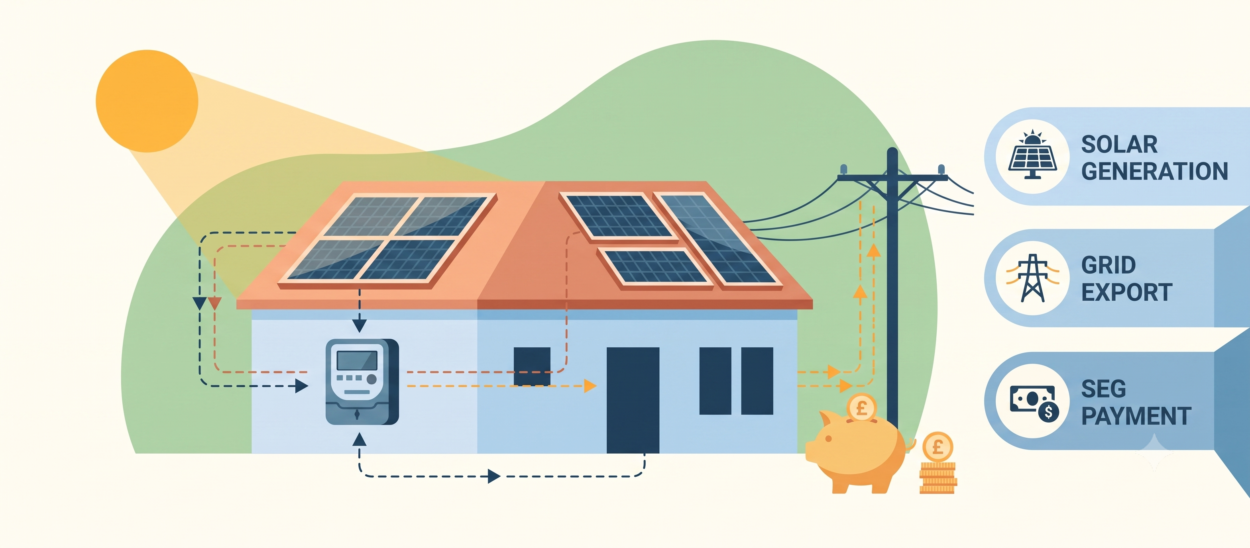
Most solar homeowners focus on reducing their energy bills, and rightly so. But fewer realise there is another financial benefit quietly available in the background: getting paid for the surplus electricity you generate but do not use. The Smart Export Guarantee (SEG)is the government-backed scheme that makes this possible. This guide covers everything you need to know about the SEG tariff in the UK:
Whether you already have panels installed or are still weighing up the decision, the SEG is part of the financial case for going solar.
The Smart Export Guarantee is a government-mandated scheme that requires licensed electricity suppliers with 150,000 or more domestic customers to offer a tariff for surplus renewable electricity exported to the national grid. If your solar panels generate more electricity than your home uses, the excess flows back into the grid, and you get paid for it.
Introduced in January 2020, the SEG replaced the Feed-in Tariff (FiT), which closed to new applications in March 2019. The key distinction is that the FiT paid homeowners for every unit of electricity generated, whether consumed in the home or exported, whereas the SEG pays only for electricity not used. It is a smaller benefit on paper, but it remains a real income stream for solar households.
The scheme covers a range of renewable technologies:
…up to 5MW capacity. In practice, most domestic solar installations qualify on size alone. The SEG is administered by Ofgem, and uptake has grown steadily: over 270,000 UK households had registered by March 2025.
The mechanics of the SEG are straightforward once you understand the basic flow of electricity in a solar home:
That exported electricity is recorded in half-hour intervals by your smart meter (or a compatible dedicated export meter). The data is shared with your chosen SEG supplier, who uses it to calculate your payments. Payments are typically made quarterly and paid directly to your nominated bank account.
Your SEG supplier does not have to be the same company you buy your electricity from. Your import tariff and your export tariff are completely independent. This means you can shop around specifically for the best solar export tariff in the UK without affecting your existing energy deal.
Eligibility for the SEG comes down to four main requirements. Checking these before you start the registration process will make everything straightforward.
If your system was installed by a reputable, MCS-certified installer and you have a smart meter in place, you are almost certainly eligible. Registration is simply the remaining step.
It depends on your export rate and which supplier you choose. Unlike the old Feed-in Tariff, SEG rates are not set by the government. Each supplier determines its own rate, and they vary considerably.
As of May 2026, fixed rates across the market range from around 6.8p per kWh at the lower end (Scottish Power) to 24-25p per kWh from suppliers such as EDF and Good Energy. Time-of-use tariffs can go higher still: Octopus Flux, for instance, pays up to 29p per kWh for households with a compatible battery that exports during peak demand hours in the evening.
To put this in concrete terms: a typical solar home in the UK exports around 1,500 kWh per year. At 10p per kWh, that amounts to roughly £150 annually. At 25p per kWh, the same export volume earns £375. The difference between the best and worst available tariffs for a typical system is well over £150 per year, which makes comparing SEG tariffs a genuinely worthwhile exercise rather than a formality.
For most UK homeowners, SEG payments are tax-free, provided the system is used primarily for self-consumption rather than for commercial generation business. If your circumstances are unusual, HMRC guidance or a tax adviser can clarify the position.
All electricity suppliers with 150,000 or more domestic customers are legally required to offer an SEG tariff. That obligation does not mean their rates are competitive. Choosing the right tariff is about understanding the different types on offer and matching them to your household.
Fixed-rate tariffs offer a set number of pence per kWh regardless of when you export. They are simple, predictable, and suit the majority of homeowners who want to register once and not think about it again.
Time-of-use or variable tariffs pay different rates depending on when the export happens. These can be significantly more lucrative, particularly if your home includes a battery storage system that lets you store surplus solar energy during the day and export it during peak evening periods when rates are at their highest.
Ofgem publishes a regularly updated list of all SEG tariffs, and independent comparison sites also track current rates. You can switch SEG suppliers at any time with no penalty, so it is worth reviewing your tariff at least once a year, even after you have registered.
When comparing tariffs, look beyond the headline pence-per-kWh figure. Consider payment frequency, whether there is a minimum export threshold before payments begin, and whether any contract terms could limit your ability to switch later.
Registering for a solar panel export payment in the UK is a five-step process that typically takes under an hour once your paperwork is in order.
Step 1: Confirm eligibility. Check that your installation is MCS-certified, that a smart meter is installed and recording export readings, and that your system is under 5MW.
Step 2: Choose a supplier. Compare current tariffs using Ofgem’s published list or a comparison site. You are not limited to your existing electricity import supplier.
Step 3: Apply. Contact your chosen SEG supplier directly, online or by telephone. You will need to provide your MCS certificate and any additional documentation they request, which is typically minimal.
Step 4: Meter setup. Confirm with the supplier that your smart meter is correctly configured to record and report half-hourly export data. The supplier will advise if any changes are needed.
Step 5: Receive payments. Once registered, payments are made automatically and typically arrive quarterly, based on your meter’s export readings.
The Feed-in Tariff was introduced in 2010 and offered generous, government-guaranteed rates for 20 to 25 years. It paid homeowners for every unit of electricity their system generated, including electricity consumed in the home. At its peak, FiT generation tariffs exceeded 40p per kWh for early adopters.
When the FiT closed to new applications in March 2019, the Smart Export Guarantee replaced it for new solar installations. The core difference is that the SEG pays only for electricity actually exported to the grid, and rates are market-driven rather than government-set. That means they can change over time, and homeowners need to register actively and review their tariff periodically.
Homeowners who were registered on the Feed-in Tariff before closure continue to receive their legacy payments for the duration of their agreement. They are not eligible to register the same installation for the SEG as well. The two schemes are entirely separate.
The SEG is less generous on paper than the old FiT, but it is still a real benefit. When viewed alongside significantly reduced electricity bills, it strengthens the overall financial case for solar installation.
Getting the best out of the Smart Export Guarantee is about more than simply registering for a good tariff. A few practical habits can make a noticeable difference.
No. Your SEG supplier and your electricity import supplier are entirely independent of each other. You can register your solar export with any qualifying SEG supplier, regardless of who you currently buy electricity from. Many homeowners find it worthwhile to choose a specialist supplier that offers a higher export rate, rather than defaulting to their existing energy company.
If you were registered on the Feed-in Tariff before March 2019, your legacy payments continue for the duration of your agreement. You are not eligible to register the same installation for the Smart Export Guarantee as well. The two schemes run separately and cannot be combined on the same system.
Yes. A smart meter, or a compatible dedicated export meter that records half-hourly data, is a firm requirement for all SEG registrations. If your home does not yet have a smart meter, your energy supplier can arrange an installation at no charge. It is worth requesting one ahead of your intended registration, as lead times can vary.
For the vast majority of UK homeowners, SEG payments are tax-free because the system is used primarily for personal energy consumption rather than commercial electricity generation. If your system is unusually large or you have other relevant circumstances, it is worth checking the current HMRC guidance or speaking with a qualified tax adviser to be certain.
Yes. There is no lock-in period and no exit penalty for switching SEG suppliers. You are free to move to a better-paying tariff at any time, and the process is straightforward. Given how much rates vary across the market and how frequently they are updated, reviewing your tariff once or twice a year is a sensible practice.
The Smart Export Guarantee is a government-backed scheme that allows homeowners with solar to earn money from the electricity they generate but do not use. The key steps are simple:
From that point, payments arrive automatically.
For homeowners who do not yet have solar panels, the SEG adds another layer to the financial case for going solar. Combined with reduced electricity bills over the system’s lifetime, the additional export income contributes meaningfully to overall returns.
If you are considering solar for your home in the South East of England, The Solar Co offers free, no-obligation roof surveys and quotes tailored to your property. Get in touch today to find out how solar could work for your home and what you could realistically earn through the SEG.
Back to Blog