
Energy Savings Calculator
0203 193 8888


0203 193 8888
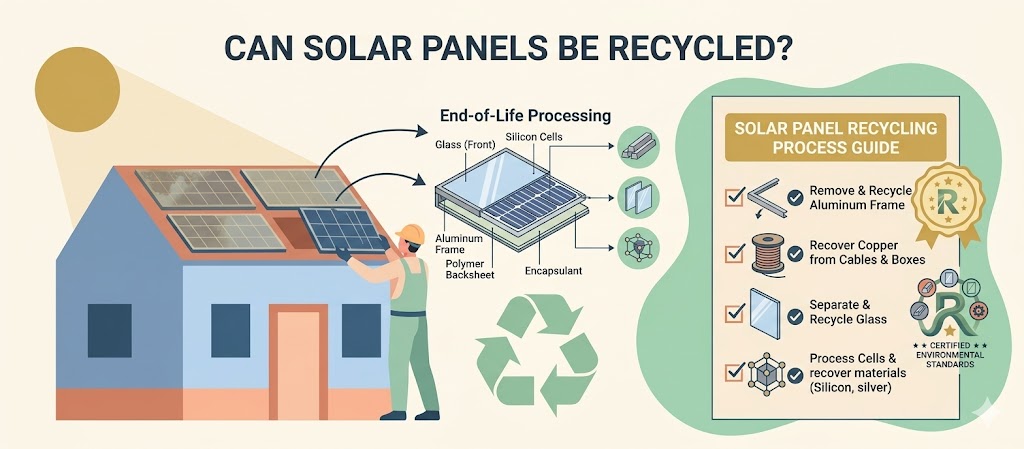
When homeowners think about going solar, the question that often lingers quietly in the background is: what actually happens to these panels in 25 or 30 years, when they finally wear out? It is a fair concern, and one worth answering clearly. The short answer is yes, solar panels are recyclable in the UK. They are regulated as electrical waste, and modern recycling facilities can recover the vast majority of the materials inside a typical solar panel.. This article covers everything South East homeowners need to know: the UK legal framework, how the recycling process works, what it realistically costs, and what practical steps to take when your system eventually reaches the end of life.
Solar panels are absolutely recyclable in the UK, and they are not destined for landfill at the end of their working life. Under UK law, they are classed as Waste Electrical and Electronic Equipment (WEEE), which means they must be processed at authorised recycling facilities rather than disposed of through general waste streams.
Modern recycling plants are highly effective at recovering the contents of a panel. Most facilities recover between 85% and 95% of the panel by weight, and the most advanced operations push that figure close to 99%. The materials recovered include glass, aluminium, silicon, copper, and small but valuable quantities of silver. Far from being a one-use technology, solar panels are part of a growing circular economy in which the raw materials from one generation of panels can feed back into the production of the next.
Choosing solar is not just clean while the panels are on your roof. With the right end-of-life pathway, it is clean all the way through.
Understanding what goes into a solar panel helps explain why recycling works and why specialist facilities are needed. A typical domestic photovoltaic (PV) panel is composed of the following materials:
The glass and aluminium frames are relatively straightforward to recycle through existing materials streams. Silicon, silver, and copper are more valuable but harder to extract from the assembled panel, so specialist thermal and chemical processes are required. Thin-film panels (using cadmium telluride or CIGS technology rather than crystalline silicon) follow a different, more specialist recycling route, but the same WEEE regulations apply.
Since 2014, solar PV panels sold in the UK have been covered by the Waste Electrical and Electronic Equipment (WEEE) Regulations. These rules place legal responsibility on the producers of panels, which means the manufacturers, importers, and sellers, rather than the end-user homeowner.
Producers are required to join a Producer Compliance Scheme (PCS), such as PV CYCLE, which funds the collection and proper recycling of panels at the end of life. In practice, this means the cost of recycling is built into the original purchase price of your panels. Homeowners should not receive a separate recycling invoice for the panels themselves when it comes time to retire them.
It is also worth noting that UK WEEE regulations were updated in 2025 and 2026 to introduce a new Digital Waste Tracking System and stricter controls on the export of waste electricals abroad. These changes are designed to ensure panels are genuinely processed at approved facilities rather than shipped overseas and lost from the regulated system.
One point worth being firm on: solar panels should not be disposed of through general waste streams and are expected to be processed through authorised WEEE routes. Fly-tipping, or disposing of panels in general waste is not only environmentally harmful; it can expose homeowners or contractors to regulatory action. Using an authorised route is both the legal and the right thing to do.
When panels are ready to be retired, the recycling journey typically follows these stages:
The recovered glass can be used in new solar panels or in other glass products. Aluminium goes back into the metals supply chain. Silicon, once re-purified, can be used in new PV cells. Silver is reclaimed for a wide range of industrial applications. The UK has a small but growing network of approved PV recycling facilities, with a significant portion of higher-grade capacity historically located in mainland Europe. As UK solar capacity expands and end-of-life volumes grow, domestic processing infrastructure is expected to scale accordingly.
Under WEEE producer responsibility rules, the recycling of the panels themselves is funded by the producer, not the homeowner. However, there are practical costs that homeowners typically bear, and it is worth being upfront about those.
The main expense is the safe removal of panels from the roof. This usually requires scaffolding and a qualified installer, and the cost varies with the system size and the complexity of roof access. Collection and transport costs vary depending on location, panel type and volume.. A full domestic system removal and recycling, including labour, scaffolding, and transport to a facility, is typically in the region of several hundred pounds plus VAT for an average-sized array.
If your original installer is still trading, they will often be the simplest route: they can arrange both the removal and the take-back via their Producer Compliance Scheme, keeping the process straightforward.
Before doing anything, it is worth checking whether the system is genuinely at the end of life or simply underperforming. A drop in output might be due to dirty panels, a faulty inverter, or a shading issue rather than panel degradation. A professional assessment could save you the cost of a full replacement and recycling process.
If recycling is the right move, here is the practical pathway:
If panels are damaged or broken mid-life, for example, after a storm, the same WEEE rules apply. Damaged panels should not go into general waste. Your home insurance policy may cover the cost of removal and replacement, so it is worth checking your policy before incurring costs.
Not every panel that leaves a roof heads straight to the shredder. Panels that still generate useful electricity, even if they no longer meet the efficiency standard for their original installation, can be tested, regraded, and resold for second-life use in off-grid systems, agricultural applications, or markets where lower-efficiency panels remain viable and valuable.
There is a growing market for refurbished PV panels in the UK and across Europe, supported by certified resellers who test and warrant the panels before resale. This can extend the productive life of a panel by a decade or more, benefitting the environment and can occasionally generate a small return for the original owner.
That said, second life has its limits. Panels in poor condition, with cracked cells, delamination, or safety concerns, should be recycled rather than resold. Reuse delays recycling but does not replace it, and the quality and safety of any resold panel must be verified before it is returned to service.
Most solar panels installed in the UK under the Feed-in Tariff boom, roughly 2010 to 2019, are still well within their 25 to 30-year operational lifespan. Current end-of-life volumes in the UK are therefore relatively modest, estimated at around 650-1,000 tonnes per year at present.
That picture will change significantly from the mid-2030s onward. Industry estimates suggest that more than 100 million panels could need to be recycled in the UK by 2050. Building the infrastructure, regulatory frameworks, and commercial recycling capacity to handle that volume is a genuinely important challenge, and one that the UK industry is beginning to address.
This is why the conversation about solar panel recycling matters now, even if your own panels are nowhere near the end of their working life. Solar is often described as a sustainable energy source, and that claim is strongest when the full lifecycle is considered: from raw material extraction, through clean energy generation, to responsible end-of-life recycling that returns those materials to productive use. Paired with WEEE regulations and an effective recycling network, solar PV is genuinely a circular technology, a stark contrast to the extract, use and discard model of fossil fuels.
Standard crystalline silicon solar panels, which represent the vast majority of domestic installations in the UK, are not classified as hazardous waste. They are classed as WEEE, which carries its own handling and disposal requirements, but they do not require the specialist containment procedures associated with hazardous materials. Thin-film panels that contain cadmium telluride are subject to additional controls because cadmium is a regulated substance, so if you have thin-film panels, it is worth flagging this when arranging recycling.
Under the UK WEEE Regulations, the cost of recycling the panels themselves is funded by the original producer, not the homeowner. What homeowners typically pay for is the removal of panels from the roof, which requires a qualified installer and often scaffolding. The total cost for a domestic system will vary depending on size, roof access, and installer charges, but the panel recycling charge itself should not fall to you under the producer responsibility scheme.
If your original installer is no longer trading, you have a few options. The panel manufacturer is a good first port of call, as they remain responsible under WEEE regardless of the installation chain. Schemes such as PV CYCLE operate independently of installers and can arrange collection from registered UK and EU facilities. Licensed WEEE waste contractors can also collect and transport panels to authorised recycling sites. Always ask for written confirmation that panels are going to an approved facility.
Yes, broken or damaged panels follow the same WEEE recycling route as panels that have simply reached the end of life. The same regulations apply, and the same authorised facilities will accept them. Do not put broken panels into general household or commercial waste streams. If the damage was caused by a storm or an insurable event, check your home building insurance first, as the cost of removal and replacement may be covered under your policy.
Modern recycling facilities can recover between 85% and 95% of a typical crystalline silicon panel by weight. The most advanced plants using thermal and chemical processes push that figure close to 99%. The glass fraction, which accounts for around 75% of the panel’s weight, is the easiest to recover. Silicon, silver, and copper require more intensive processing but are valuable enough to make the effort commercially worthwhile. Aluminium from the frame is also straightforwardly recycled. Only a small residue of polymer materials represents genuinely unrecoverable waste.
Most modern panels continue generating electricity after 25 years, albeit at a lower output. End-of-life usually reflects declining performance rather than a sudden failure. Solar panels are not just clean while they are generating electricity on your roof. When their working life ends, they are recyclable and regulated, and the materials inside them can be recovered and reused in new products and new panels. Under the UK WEEE Regulations, the recycling cost is largely built into the original purchase price, and the practical burden on homeowners is light: arrange removal through a qualified installer and confirm the panels are going to an authorised facility.
With end-of-life volumes set to grow substantially over the coming decades, the infrastructure and regulations supporting solar recycling in the UK are developing to meet that challenge. Solar PV, done well, is a genuinely circular technology and a responsible long-term investment for your home.
If you are a South East homeowner thinking about solar and want to work with an installer who plans for the full lifecycle of the system, from installation through to eventual recycling, The Solar Co can help. We offer straightforward, sustainability-led advice and full-lifecycle support for every system we install.
Back to Blog