
Energy Savings Calculator
0203 193 8888


0203 193 8888
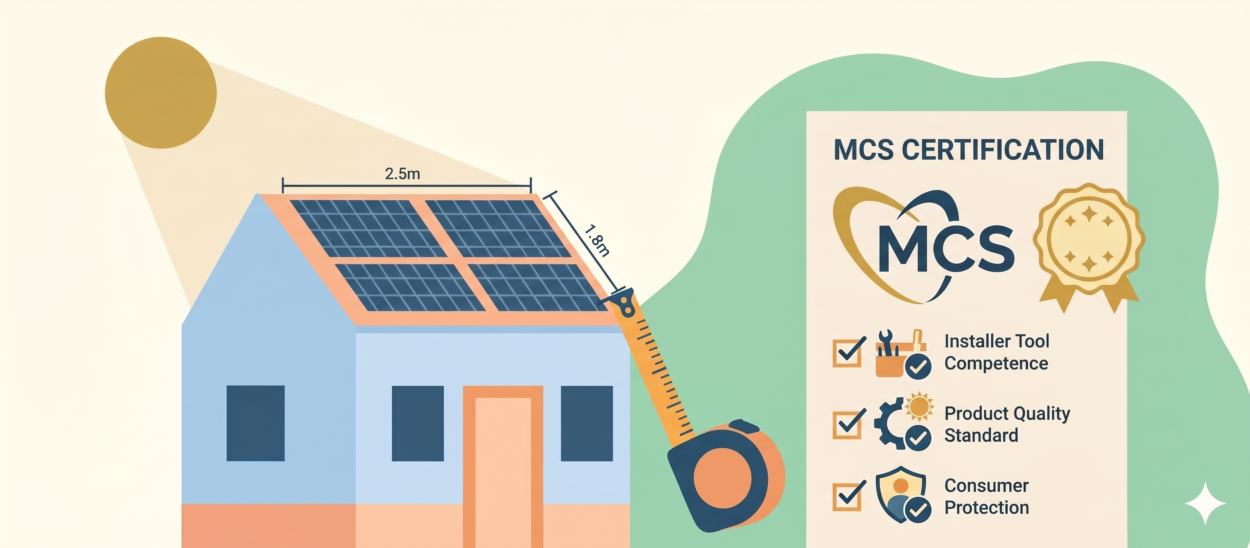
When comparing two solar quotes, you may encounter one company that is certified under the Microgeneration Certification Scheme (MCS) and one that isn’t. In practice, MCS certification is still the benchmark most homeowners, insurers, and lenders expect – the MCS-certified company helps ensure:
This guide will show you:
The Microgeneration Certification Scheme was originally set up by the government in 2006 as a nationally recognised quality mark for small-scale low-carbon installations. It became an independent, profit-for-purpose organisation in 2018 and is now one of the main certification schemes used for solar installations in the UK, alongside alternatives such as Flexi-Orb.
MCS covers a range of small-scale low-carbon installations that include:
The scheme covers both the products being used by installers and the installers themselves, so installers must use MCS-certified components. Consequently, the certification scheme covers the entire installation process from design to installer competence, customer service and post-installation handover documentation.
To meet MCS certification requirements, every competent installer is independently audited against their standards, reducing the risk of unsafe or underperforming installs.
MCS certification also requires the company to be a member of the RECC, HEIC or GGF. These are consumer protection bodies that cover you if, for example, you enter into dispute with us or we cease trading, and you need to be compensated for incomplete work.
In addition to addressing potential problems, an installer’s MCS membership will give you confidence in the installation’s performance. Once the installer has completed the project, the MCS handover pack will confirm your expected annual generation and allow you to check the savings claims made in the sales process against reality.
At a practical level, MCS certification offers you assurance that the installer has the required expertise in electrical, structural and roofing disciplines – and this is not just self-declared.
Regardless of how much energy you use, your solar panels will still produce the same energy for a given amount of sunlight on a given day. The battery, if you have one installed, will store some of the energy too.
The excess energy beyond that stored and used will then be sent to the grid. This is where the Smart Export Guarantee (SEG) comes in – you will sell that excess energy to a supplier for between 4p-15p/kWh at 2026 prices, depending on whom you choose to sell it to. Octopus Outgoing Fixed is the generally accepted benchmark.
To access SEG payments, you must have had your system installed under an approved certification scheme — most commonly MCS. Suppliers will require approved certification before accepting an SEG application.
As well as the SEG, solar panels are also 0% VAT, and will remain so until at least 2027. Beyond the straight-up money-making potential of your installation, there are other benefits to having an MCS-certified installer, some of which are essential to home ownership.
Most suppliers, lenders and insurers are familiar with MCS as the default standard. Using a less widely recognised scheme can introduce additional checks or delays. If you’re planning to get government support for the install, ECO4, the Great British Insulation Scheme and Warm Homes Funding all require an MCS installer.
With other institutions recognising the scheme, certification matters in practice, as without such accreditation, there could be headaches down the line.
Not all solar PV installers are MCS-certified. In your search for one, you may encounter claims such as ‘MCS-style’ or ‘MCS-equivalent’. These do not explicitly state ‘MCS-certified’ and should be a warning sign. If you do contract them, and they fail to issue an MCS certificate within 10 working days, you could face delays, missed SEG payments, and complications later.
You need to be certain that the company is certified from the outset. If you are uncertain of a company’s certification, use the mcscertified.com Find an Installer tool to confirm that they are currently listed and that their certification specifically covers solar PV.
Take a note of their six-digit MCS certification number and ask them to confirm it on their quote and contract. After the installation team installs the array, your unique microgeneration certificate will be available from the MCS Installers Database at certificate.microgenerationcertification.org. You can access it by entering your property address. Additionally, you can confirm this by calling the MCS Customer Helpdesk on 0333 103 8130.
The legal and financial complications of not using an MCS-certified installer include:
The MCS is one of the main nationally recognised accreditation schemes (Flexi-Orb being the other) that are likely to be baseline eligibility requirements for future grant or funding schemes.
To be accredited by the MCS, installers must demonstrate technical competence, have suitable insurance, and have a documented quality management system. The technical competence includes:
Additionally, certified installers must use only MCS-certified products where required under the scheme — panels, inverters and batteries that themselves carry the standard. They must undergo annual audits and surveillance assessments to verify their ongoing compliance. For repeated failures, they can lose their certification or have it suspended until the issues are rectified.
The Solar Co is fully MCS-certified for solar PV and battery storage, with every install delivered under our membership of an approved consumer code — giving homeowners the full set of protections by default.
No — MCS certification is not a legal requirement to install solar panels. However, it is required if you want to access schemes like the Smart Export Guarantee (SEG) and is widely seen as a mark of quality and compliance.
Typically within a few days to a couple of weeks after installation. The installer submits the system details to the MCS database, and once processed, you’ll receive the certificate needed for SEG payments.
Flexi-Orb is a newer alternative certification route that is also recognised for SEG eligibility. However, MCS remains the most established scheme in the UK market and is more widely recognised across insurers, lenders and energy suppliers.
In most cases, no. MCS certification must be issued by an MCS-certified installer at the time of installation. Some companies may offer a full inspection and reinstallation to bring a system up to MCS standards, but this can be costly.
Yes — MCS certification now covers battery storage systems as well as solar PV, provided they are installed by an MCS-certified installer. This ensures the system meets required safety and performance standards.
MCS certification is what separates a compliant, future-proof solar installation from one that may fail at the first claim, sale or insurance renewal.
The three most important things it ensures are Smart Export Guarantee eligibility, insurance cover and resale confidence. If you are uncertain about an installer’s claim to have MCS certification, check them online at MCScertified.com.
Every quote and installation offered by The Solar Co is MCS-certified, and you can be assured of the quality and safety of our work, with all the paperwork handled on your behalf. Get in touch with us for a free, no-obligation quote today.
Back to Blog