
Energy Savings Calculator
0203 193 8888


0203 193 8888
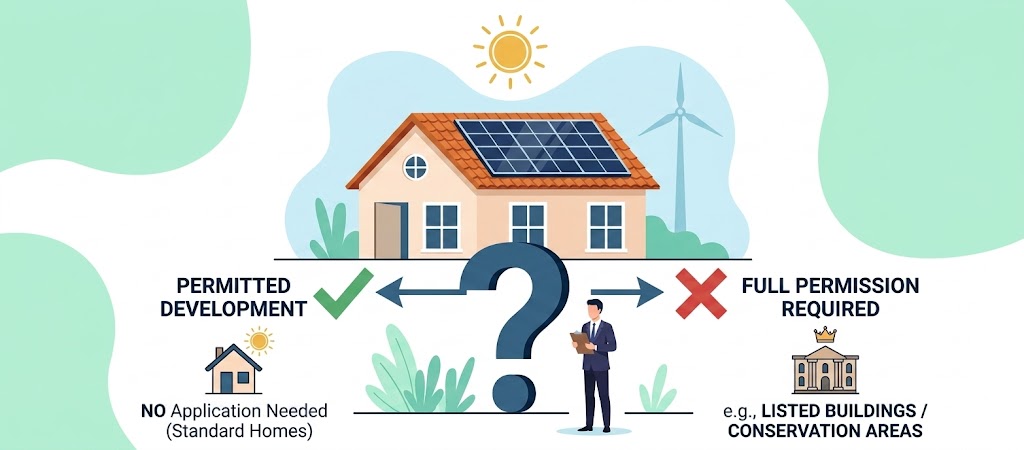
In most cases, you don’t need planning permission to have solar panels installed. Such an installation is usually considered ‘Permitted Development’ on most homes in the UK.
This guide explains when planning permission is required — typically in the following cases:
Although most homes can install solar panels without planning permission, all systems must comply with building regulations. Get in touch with us at The Solar Co today to get a free survey for solar panels.
In England, the majority of residential solar panel systems are classed as ‘permitted development’ under Part 14 of the Town and Country Planning (General Permitted Development) Order (GPDO) 2015.
Thanks to the permitted development designation, if it is a roof-mounted system on a house or bungalow, your solar array is typically permitted without a planning application. You do not need to submit a planning application to your local council.
MCS-accredited companies like The Solar Co are familiar with permitted development rules. They will tell you if this designation applies to you before they begin installing the array.
Permitted development rights are a set of pre-approved planning permissions that are granted by the government. They allow homeowners to make certain improvements (such as solar panels) without getting approval from the local authority.
Section A, Part 14 of the General Permitted Development Order (GPDO) 2015 covers solar panels. The regulation states that a solar system can be fitted to houses and bungalows with flat or pitched roofs. These rules generally apply to houses and bungalows. Additional restrictions may apply in conservation areas, on listed buildings, or for certain non-residential properties. An MCS-approved installer can advise you if your planned solar system meets the requirements.
Permitted development does not excuse you from meeting building regulations, which we cover in another article. These are safety and compliance requirements that apply to every large electrical installation, including solar panels and home batteries.
To meet permitted development rules, a solar array must conform to the following limits:
There are exceptions to permitted development – we will discuss these in the next section.
Planning permission is required in a small number of cases, including:
We will discuss the finer details of some of these exceptions in the following sections.
If you live in a conservation area, this does not automatically mean that you need planning permission. There are additional restrictions, but as long as these are adhered to, it is usually possible to go ahead with the installation.
The key restriction is that the system cannot be installed on a wall or roof slope that faces a highway and is visible from it. It could mean that if the front of your house is south-facing, you may only be able to have north-facing panels.
In some conservation areas, planning permission for new housing can include an Article 4 Direction (A4D) that removes permitted development rights. If you are unsure, check with your local planning authority, though this should be in the house’s Deeds.
Since December 2023, flat-roof solar arrays have been covered by permitted development rules, bringing them in line with homes elsewhere.
As part of our pre-installation survey, The Solar Co will assess your planning status and advise you on whether you require planning permission. If you do, we will prepare and submit a planning application on your behalf.
Though relatively few in number, the main category of housing that requires planning permission is listed buildings. In these cases, any alteration to the structure or appearance of a listed building needs listed building consent.
There are three grades of listed building in England:
If you do live in a listed building, this doesn’t necessarily prevent an installation. Planning committees do permit solar panels in some cases, provided they are discreet and reversible. It helps to have a pre-application conversation with your local authority before the process begins. You should get the job done by a specialist installer like us at The Solar Co, who will be familiar with the rules involved.
Regardless of whether you need planning permission, your solar panels must always comply with building regulations. In another guide, we go into detail on this.
Building regulations ensure that the panels are installed safely, and cover the structural integrity of the roof, electrical safety and fire safety. In practice, an MCS-certified installer like The Solar Co will ensure that the work meets the standards and can self-certify the system. You will also be given a Building Regulations completion certificate after the installation, which helps with insurance and property sales.
In addition to building regulations, you will often have to go through a process with the electrical Distribution Network Operator (DNO) under the G98 or G99 rules. Your MCS-certified installer will follow this process before fitting the panels.
No — there’s no formal requirement to notify neighbours if your installation falls under permitted development. However, it’s often a good idea to let them know in advance, particularly if scaffolding or access could affect them during installation.
In most cases, no. Battery storage systems installed inside the home don’t require planning permission. If the battery is installed externally, there may be size or location restrictions, so it’s worth checking with your installer.
If your installation is permitted development, neighbours don’t have a formal right to object. However, if planning permission is required — for example, in a conservation area or on a listed building — neighbours can submit comments as part of the planning process.
A standard planning application typically takes around 8 weeks to be decided by the local authority. Pre-application discussions can sometimes help identify any issues early and reduce delays.
Yes. If planning permission is required, your installer will usually manage the application process on your behalf, including drawings, documentation, and communication with the local authority.
Thanks to permitted development rights, you will not usually need planning permission for solar panels. There are important exceptions, including those for listed buildings and homes in conservation areas. Building regulations always apply, and your MCS-certified installer will ensure that the solar array complies with them.
Contact The Solar Co for a free assessment to confirm whether your home qualifies under permitted development. Should there be any planning constraints, we will handle any approvals required should you go ahead with us.
Back to Blog